Thursday, June 15, 2006

Small is Big


Geoff Warner's Wee House is actually 800 Square Feet. Small is definitely the new big, according to the Wall Street Journal. Says the Journal: "Designers say microhome buyers tend to fall into one of two groups: The majority are looking for a secondary space, either a vacation home or a building near or attached to a primary residence. A minority of buyers are hoping to move into a minihouse full-time, motivated by a desire to simplify their lifestyles or by social and environmental concerns about the amount of living space people need.....Living in a tiny home, as opposed to doing yoga in it or using it for vacations, often appeals to people who want simpler lives that leave less of an ecological "footprint."

Monday, June 12, 2006

Mortgage Rates

30 Year Fixed: 6.62%

15 Year Fixed: 6.23%

1 Year Adj: 5.63%

Sunday, June 11, 2006

We'd All Like Cheaper Housing but...


We found this item on the website of the National Association of Home Builders.
Sounds like the best thing since sliced bread, but it's only part of the bill:

Bipartisan Bill To Improve Federal Storm Water Program Would Boost Housing Affordability

June 9, 2006 - Legislation introduced yesterday by Rep. John Duncan (R-Tenn.) and 17 bipartisan cosponsors would update and improve Environmental Protection Agency storm water permit and enforcement policies that have needlessly harmed housing affordability, according to the National Association of Home Builders (NAHB).

“Current storm water permitting requirements and regulations are duplicative and burdensome, adding anywhere from $1,400 to $4,500 to the cost of every lot,” said NAHB President David Pressly, a home builder from Statesville, N.C. “The legislation takes into account the differences between residential construction activity and other industries. By taking a more balanced and reasonable approach to storm water management and enforcement, the measure would streamline the permit process, improve compliance and enhance environmental protection.”

H.R. 5558, the “Stormwater Enforcement and Permitting Act,” contains a number of provisions that would protect the environment without needlessly driving up housing costs. The bill would:

- Develop a program to increase awareness among residential construction site operators of their regulatory requirements

- Create a fair and reasonable process by which the Environmental Protection Agency can seek information from residential construction site operators

- Allow builders a one-time chance to correct permit deficiencies that don’t cause environmental harm

- Remove duplicative permit obligations where residential construction site operators discharge into municipal storm sewer systems that are already permitted and regulated

- Allow authorized states to assume the lead enforcement role

- Provide statutory authorization for EPA’s current practice of issuing general permits

At a time when housing affordability is becoming a national issue, and duplicative and burdensome storm water regulations are pushing up the cost of housing and pricing a growing number of families out of the market for homeownership, the time has come to update and improve these requirements, Pressly said. A more consistent and sensible regulatory approach would better protect America’s rivers and streams without unduly increasing housing costs, he added.

More to come....

Saturday, June 10, 2006

Global-Warming on Montclair's Front Burner

Gray Russell gave his own alternative energy presentation recently in Bloomfield (photo)

Thursday's NJ Star Ledger has an interesting follow up to Al Gore's "An Inconvenient Truth" by reporter Phillip Reade:

Gray Russell has seen Al Gore's global-warming flick "An Inconvenient Truth."

The film starring the former vice president has been pulling in record-breaking audiences and filling up seats at Montclair's Claridge Theater... "I think it's the issue of our time, I really do," said Russell, the hybrid Toyota Prius-driving environmental coordinator.

This summer, Rosdaria Matos and others will be going door to door to raise the pressure on Corzine to follow through on NJPIRG's agenda.
The group's solution checklist includes doubling rebates for solar and other renewable energy; building an 80-turbine, 350 megawatt wind-energy pilot project offshore and enacting a gas-guzzler fee on vehicles that get 22 miles per gallon or less, with the revenues used as incentives for fuel efficiency.
Yesterday, Brendan Gilfillan, a spokesman for the governor, pointed to Corzine's record in the U.S. Senate, including his "yea" votes on caps on greenhouse emissions -- which failed -- and his vote against an energy-bill amendment that he said did not go far enough to reduce emissions.

"Despite the lack of leadership on the federal level, Gov. Corzine remains committed to doing what he can in the state to address this global challenge," Gilfillan said.

Last week, in its second weekend, Gore's documentary broke into the Top 10 with $1.33 million in ticket sales, even though it was playing in only 77 theaters. It draws parallels between rising temperatures and their resulting catastrophic hurricanes and cycles of drenching floods and bone-drying drought.

Montclair was chosen, in part, because it is the first New Jersey town to win the Board of Public Utilities' Clean Energy Leadership Award. "We're walking the walk, not just talking the talk," Russell said of Montclair's "green" reputation.

Montclair has traffic lights with LED, or light-emitting diodes, saving $10,000 a year in energy costs; has a small fleet of municipal vehicles powered by compressed natural gas; and is about to build a school with solar panels and a geo- thermal heating and cooling system.

In the autumn, Russell joined an Earthwatch team of scientists on Canada's northern reaches, near the Arctic Circle, to study the permafrost, moisture that lies below the ground and, when fully frozen, deflects the sun's heating rays.

That permafrost, in places, is now forming puddles, and the sun's heat is instead absorbed by the water, speeding up the melting and releasing greenhouse gases in the process.

"The permafrost, for the first time in 10,000 years, is thawing," he said.

Friday, June 09, 2006

Closet Phobia


From Pogue's Posts:

There’s a housing complex in Hong Kong whose 100 rooms are each ten feet square.

Photographer Michael Wolf painstakingly took a photograph in each one, showing its occupant and furniture. The result is a set of 100 bizarre, thought-provoking photos–a theme and variations.

One look, and you’ll never complain about the size of your place again.

Thursday, June 08, 2006

Ecoresin


3form is generating buzz in design circles with a very cool material called eco-resin .
Ecoresin is a proprietary translucent, co-polyester sheet material that contains a significant amount of recycled content but also retains its core physical properties. But what is it used for? Ecoresin is used as the building block to produce products such as those pictured above and results in architectural panels that have superior optical, mechanical and fire properties and that promote clean air quality.

We’re not completely sure what all that means, but their website looks really cool. Plus, they are a contributor to the National Building Museum’s The Green House: New Directions in Sustainable Architecture and Design - an exhibit investigating new green home ideas, solutions and debates.

Monday, June 05, 2006

Global Warming Reality Bites

From Sunday's Times Week In Review:
While much of the discussion of climate change focuses on the big picture of rising sea levels and increasing global air and ocean temperatures, the Duke finding helps explain the smaller picture. Climate change may be a real nuisance in the backyard.

Poison ivy is only the latest entry on a growing list of pests, both plant and animal, that may be nurtured. Japanese beetles, a voracious eater of turf and trees, live longer under higher levels of carbon dioxide. The ranges of other invasive insects, like fire ants, are expected to increase as the planet warms. Disease-carrying ticks have already been shown to have moved northward in Sweden. Mosquitoes could fly farther, too.

Sunday, June 04, 2006

Where to Spend that Summer Weekend?


Or should you just relax and watch your garden grow?
David Carr writes "You Are Where You Tan" from a Montclair perspective in the NY Times:

In our neighborhood, everyone has a version of Someplace Else. The people across the street split for Fire Island. The couple next door have a place in the Hamptons they give over to renters for most of the season, enjoying it on the margins. Our best friends on the block belong to a beach club on a tidy lake in the low-slung mountains of Jersey, and many of the others head out to destinations near and far on the Jersey Shore....There is something terribly existential in all of this: Work all of your life to scratch out a piece of suburban idyll, and then work some more so you can afford to get the hell away from it.

Friday, June 02, 2006

MeadowFest


Saturday, June 10, 2006
Sunday, June 11, 2006 - raindate

11:00am - 4:00pm

Laurel Hill County Park, Secaucus

MeadowFest(formerly RiverFest) is the centerpiece eco-tourism event in the region and is a platform to highlight the activities and purpose of the New Jersey Meadowlands Commission through community building. MeadowFest's target audience is families, couples and individuals interested in wholesome activity and community fun.

The day-long event will feature educational activities, games, music, food and more. There will also be narrated pontoon boat tours along the Hackensack River that will run throughout the day. Prior to the day's events, the Meadowlands Liberty Convention and Visitors Bureau will host the first Meadowlands Liberty Eco-Triathlon.

Thursday, June 01, 2006

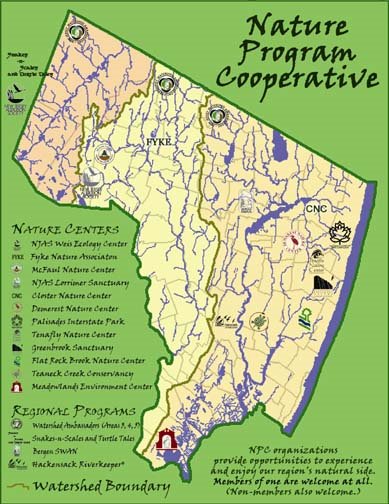
Nature Program Cooperative


Nature Program Cooperative is a network of environmental organizations.
NPC member organizations provide opportunities to experience and enjoy our region's natural side. Members of one are welcome at all. (Non-members also welcome.)

Tuesday, May 30, 2006

The Plot Thickens at Zoning Board


Bloomfield residents react to initial unveiling of plans for 28 Unit apartment complex.

The developers’ presentation for the 28-Unit Apartment House at 1242 Broad Street is scheduled to continue at a special meeting of the Bloomfield Zoning Board this coming Thursday, June 1st, at 7:30 PM in the Town Council chambers. At this meeting Ralph Salerno, the developers’ lawyer, will present his final two witnesses: a traffic expert and a town planner.

Sunday, May 28, 2006

Even More Virtual Home Searches


Over 70% of homebuyers use the internet at some point in their search.
The most comprehensive site is still Realtor.com and is new sister site Move.com(formerly Homestore)

There's still the Garden state Multiple Listing public site(GSMLS.com). There's also Zillow.com, and, of course, Century 21.com.

Meanwhile, Trulia.com, a real estate information site is expanding its coverage to a number of key states, including California, New York, New Jersey, Texas and Florida. It plans to go to five other states later this year. Trulia is a simplified real estate search engine, with results placed on Google maps from the beginning rather the end of the search process. It's still in a Beta version with overlapping zip codes and only about 20% of available listings in Bloomfield, for example. But it could be a good starting point for buyers to dip their fingers into the housing market.

Friday, May 26, 2006

“I think the environment should be put in the category of our national security. Defense of our resources is just as important as defense abroad. Otherwise what is there to defend?"

Robert Redford

Downsizing McMansions


From the Star-Ledger:
On Tuesday night, Montclair's council introduced an ordinance that would rein in what many characterize as McMansions, introducing a coverage limit in R-1 and R-2 zones of 25 percent. In R-0, or residential mountain zones, the maxi mum coverage would be 20 percent.

On a 60-foot-by-150 foot lot, for example, simple setback requirements now allow 49 percent coverage, meaning a two-story house could have some 8,800 square feet, not counting any finished attic or basement. A 25 percent coverage would allow for a two-story house with 4,466 square feet; add a half- story -- Montclair's maximum allowable-- and the house would approach 5,600 square feet of living space.

"The net result would be reducing the size of houses," Mayor Ed Remsen said as the council scheduled a June 13 public hearing.

Wednesday, May 24, 2006

Aaah....Presby is Peaking


Montclair's pride and joy iris garden comes int it's own this weekend with acres mof rarely seen varieties on the gentle lower slopes of Mountainside Park(Upper Mountain Ave south of Mt. Hebron) Live music, tours, and a new gift shop. The big day-long celebration is on Satuday, May 27, from 10 to 4.
Live musical entertainment will begin at 1 p.m.
There will be balloons and face painting for kids.
For more information, see the website at http://presbyiris.tripod.com
Rain Date is SUNDAY.
This is the weekend for local festivities. Stay tuned.

Sunday, May 21, 2006

In Back of the Bus


It took a lot of people to move that bus in front of the Turner family's new home.

About one hundred anonymous community members, including the Mayor of Irvington, NJ and sent a news article to "Extreme Makeover: Home Edition," hoping the design team could help! And now that the smoke has cleared, hundreds of dedicated contractors and workers, local builder Edgewood Properties and Clifton's Century 21 Construction(no connection to Century 21 Real Estate) and volunteers transformed the Turners' burned out house into a dream home in a remarkable seven days.

Roads were closed, celebrities showed up and neighbors gawked at the small army of blue-shirted contractors turning one disadvantaged family's modest house into a well-designed home. They also designed and rebuilt a much needed neighborhood park that will be a major asset to the town.

After finishing the season finalle, the crew moved up to Bergenfield for another Extreme Makeover to be broadcast later this summer.

The Llanes family - includes a blind father, a mother with cancer, a blind grandmother, two daughters who are going blind and a deaf son.

Along with demolishing and rebuilding the home's interior, the companies will pack the home with $100,000 worth of the latest technology designed to help people with vision and hearing problems.

"This house will have every piece of technology in it that we know exists on the planet Earth to help a family with disabilities," said Brian Stolar, president and CEO of developer Pinnacle, which is handling the 24-hour-a-day building effort.

The house will have the latest solar panels from BP Solar and the latest home-control software from Home Automated Living of Maryland. A member of the Llanes family will be able to speak into a phone or microphone and tell the system, for example, to turn out the lights or raise the thermostat.

Victor Llanes, the blind father, will be able to communicate more easily with his deaf son, Zeb, 16, using a software program called iCommunicator, which converts text to sign language.

"It was a house that was disabled," said deaf actress Marlee Matlin, who has met the Llanes family. "They are going to have less stressful lives," the actress said through a sign-language interpreter.

Saturday, May 20, 2006

Danger Years for Homeowners


Some Realty Realities courtesy Bryant Nielson,
of 1st Metropolitan Mortgage in Tenafly:

Delinquencies peak the third and fourth years of mortgages.

It is reported that although borrowers are often told that the first year is the hardest, delinquencies have historically reached their highest points during the third and fourth years of mortgages.

There are a few forces at play: After years of strained budgets, borrowers may have little in savings to draw on to handle a crisis; this is also the period when major repairs begin to crop up; finally, many home buyers go through life changes, including starting a family.

The number of Americans affected by the coming danger years could be huge. It is further reported that half of all mortgage loans are three years old or less. Nearly $3 trillion in mortgages originated in 2002, $4 trillion in 2003 and $3 trillion again in 2004. Many were refis, but there were also record totals of new purchases as well.

In addition, many of these transactions involved risky loans, such as interest-only ARMs and no-down payment loans.

A recent report found that the median new home buyer put down just 2 percent in 2005. Forty-three percent put down no money at all. And according to SMR Research, some 25 percent of loans were interest-only, do nothing to reduce the debt on the house.

Lenders used to offer interest-only loans to only the best credit-quality prospects and that is no longer true.

Adjustable rate loans accounted for nearly half, by dollar volume, of loans issued in 2004 and 2005. Because interest rates have risen and are expected to increase further, those loans will adjust upward and monthly payments will be higher.

With a $200,000 loan adjusting upward from 4 percent to 6 percent, the monthly bill would increase to about $1,200 from $955.

Yet most homeowners are safe. 35 percent of all homeowners carry no mortgages at all and another 50 percent have traditional fixed-rate loans, which leaves only 15 percent of all homeowners at risk.

It I also pointed out that some who have opted for nontraditional mortgages are affluent and choose these products to free up cash for more lucrative investments. The risk to these financially savvy individuals is low; most can pay off their mortgages any time.

Furthermore, those who bought a few years ago when real estate was hot, may already be in safe territory, as the value of their homes has grown enough that they now have enough equity to ride out financial storms.

But even if the percentages of borrowers who may go into default remains modest, even an increase of a few percentage points can add up to millions of households.

Big price gains are ending
And housing seems to be headed, if not into a decline, at least into a period of much more stable, slower growth. The median home is predicted to inch up by only a few percent in 2006, according to NAR. In many markets, prices may fall. Home buyers cannot count on increasing home equity to bail them out of tight situations.

Friday, May 19, 2006

Open Garden Time!

Pat Kenschaft has an open garden for all seasons. This picture was from her December Open Garden.
All are invited to see Pat Kenschaft's spring harvest Saturday. Here's an excerpt from her latest newsletter:

Speaking of weeds, there are plenty for me this year too. My yard may not be as tidy this Saturday for my Open Garden (56 Gordonhurst Ave.) as I try to make it when I invite in the public. Grace Grund (3 Dodd Street) and I are looking forward to seeing you Saturday, May 20 from 2-5 PM. Grace will be holding a chicken-raising workshop beginning at 3:00 PM and my front yard will be hosting a variety of interesting tables. It takes little time to raise vegetables, but this business of looking suburban...

On the good side, vegetables are growing well too. My brocolli look
like brocolli, and I may harvest one before Saturday. There is a Sugan Ann
pea that will be ready to show off. I have THREE green tomatoes, one
larger than a pea. My mother said that gardeners need to brag. Please come
help me Saturday, and see the wonders of weeds and other good things!

Pat

Thursday, May 18, 2006

BNA Promotes Local Transparency


The Bloomfield Neighborhood Association will be hosting a meeting on Saturday (May 20) regarding transparency in local government. The meeting will be held in the Art Room at the Bloomfield College Library. More info:

On Saturday, May 20, at 10 a.m., in the Art Room of the Bloomfield College Library, the Bloomfield Neighborhood Association will be hosting two guest speakers: Councilwoman Janice Maly(far right in photo), who will be giving a status report on the hiring of a Channel 35 station manager, as well as the overall progress of township’s efforts to televise all public meetings; and Martin O’Shea, a West Milford activist who helped draft a new open government bill currently before both the state senate and assembly (S-1219/A-2762). The Art Room is accessible through the library’s main reading room.
Martin O’Shea is one of the primary drafters of the bill, which is intended to reform the Open Public Meetings Act, which became state law in 1975.

Introduced in January 2006 by State Senators Robert Martin (R-Morris Plains) and Ellen Karcher (D-Freehold), Senate Bill 1219 would compel public bodies, among other things, to hold open meetings of all subcommittees, require them to post relevant public information on a website and require them to record and keep more comprehensive minutes of all meetings. An identical bill was simultaneously introduced to the assembly.

O’Shea has been active for years in the Township of West Milford monitoring meetings of the municipality’s council, board of education and planning board. He has also worked on open government issues with other activists around the state.

Tuesday, May 16, 2006

Existing-Home Sales Ease in 1st Quarter

Existing-home sales, including single-family and condo, remained historically high in the first quarter but have experienced a downtrend since hitting a record in the third quarter of last year. Even so, 26 states showed increases in sales activity from a year ago, according to the Natioma; Association of Realtors®.

The latest report on total existing-home sales shows that the seasonally adjusted annual rate* was 6.80 million units in the first quarter, down 2.1 percent from the 6.94 million-unit level in the first quarter of 2005.

The biggest increase was in New Mexico, where existing-home sales rose 26.2 percent from the first quarter of 2005. Eight other states recorded double-digit sales increases from a year ago. Twenty-one states and the District of Columbia experienced declines.

David Lereah, NAR’s chief economist, said rising interest rates have dampened sales. “A steady rise in mortgage interest rates has slowed home sales in higher cost areas, yet job growth in some moderately priced markets is boosting sales in other areas,” he said. “The net effect is a modest decline in home sales for the nation as a whole, but sales remain historically strong and are providing a solid underlying base for the overall economy.”

According to Freddie Mac, the national average commitment rate on a 30-year conventional fixed-rate mortgage was 6.24 percent in the first quarter, up from 6.22 percent in the fourth quarter; it was 5.76 percent in the first quarter of 2005.

NAR President Thomas M. Stevens from Vienna, Va., said the sales pattern is expected to level out. “We project home sales may soften a little further before picking up in the fourth quarter, but we’re not looking for any significant changes in the market moving forward,” said Stevens, senior vice president of NRT Inc. “This should provide stability in the market so that buyers and sellers will be on a fairly level playing field in most of the country.”

Monday, May 15, 2006

No More Knocks On This Door!


Clymer, NY, (near Lake Erie)has the distinction of having the home with the ugliest door in America. The door company Therma-Tru is replacing this blue-and-red door with a more appealing entryway valued at $3,000 to $5,000. The owners, for now, prefer to remain anonymous.

The company's message is that an attractive door has more than aesthetic value:
Replacing an old entry door with a new fiberglass entry system increases the perceived value of a home by as much as $24,000 – up to six percent of the home’s value.

Sunday, May 14, 2006

Fauna to Awaken that Quiet Backyard


This year's Backyard Habitat Fair was held on perfectly sunny Saturday at St. James Church in the heart of in Upper Montclair. A great opportunity to find out more about backyard habitat, composting, native plants and local environmental projects and how to get your yard certified by the National Wildlife Federation.

The Montclair Backyard Habitat Project is working with the National Wildlife Federation (NWF) to promote the creation of habitat friendly to both people and wildlife.If you couldn't make this annual event, you should check out their excellent website

We have a new vision of what a suburban community can be. Moving away from the traditional focus on sterile and even toxic lawns, we seek to preserve and enhance habitat through natural landscaping, using native plants and design techniques that provide food and shelter for birds, butterflies, and other desired wildlife.

The NWF has a program to promote exactly this kind of shift in yard care by encouraging towns to become certified as Community Wildlife Habitats. Our goal is to turn Montclair into a NWF-certified Community Wildlife Habitat by 2010.

Thursday, May 11, 2006

How Old Is Your House in Light Years?


From Joyce Cohen in todays NY Times "Walk Through":

Did you know that May is Electrical Safety Month?

Underwriters Laboratories is publicizing the dangers of electric wiring in older homes. The group says a third of the country’s housing stock has wiring that is 50 years old or older.

The Residential Electrical System Aging Research Project finds that faulty wiring can be a hidden fire hazard. There aren’t always flickering lights, frayed cords or acrid electric-burning smells to let you know something’s wrong. “Bad things can be happening inside walls even without these warning signs,” says UL.

Even such innocent mistakes as “overlamping” a fixture — using a 100-watt bulb when the fixture is made for 60 watts — can wreck the wiring over time, causing a fire.

Wednesday, May 10, 2006

Bear Market

R.I.P.
courtesy www.millstreetdesign.com
That bear tracking story is one of the hottest ever over at Baristanet. We've clocked 4 reports in two days with 172 coments.

Tuesday, May 09, 2006

Bubble Bet


Suppose you're finally ready to buy that home, but you can no longer count on its value appreciating each year as it has in the past decade.
If you have a big mortgage and little equity, you might be feeling a little squeamish about all this talk of soft markets. In this week's New Yorker, James Surowiecki describes some new ways you might be able to protect yourself:

There is one much feared cataclysm, though, against which everyone has so far been defenseless—a housing-price slump. Seemingly every magazine and newspaper in America has now prophesied the imminent bursting of the housing bubble. But even though many Americans have invested all, or almost all, their net worth in their homes, they’ve had no way of insuring themselves against that asset’s value taking a severe tumble.
That’s all changing. At a new online site called HedgeStreet, investors can bet on changes in home prices in certain cities. And later this month the Chicago Mercantile Exchange is going to start trading futures contracts pegged to housing-price indexes in ten major metropolitan areas

As you might do with hog futures, you can sell contracts that will reap you a profit if local prices fall, allowing you to lock in the current value of your home. Alternatively, if you think the housing boom in this area still has a ways to run—or if you’re interested in buying a year from now but are afraid that you’ll be priced out of the market—you can place a bet that will pay off if prices keep going up. Thanks to www.truegotham.com.

Monday, May 08, 2006

Move over Harvest Fest!


Bloomfield's first Health and Wellness Fair, covering much of the Town Green on Saturday, was a natural outlet for a vigorous community spirit in the diverse township. It was a fun family event with lots of healthy exhibits and events to keep the crowd entertained, fed, and informed. A free picnic BBQ, courtesy of Shoprite, a DJ, give aways, and activities for kids of all ages. And then there's a buffet of of alternative medicine demonstrations including Massage Therapy, Reflexology, Healthy Cooking Demonstrations, Home Emergency Preparedness, Hearing Screenings, Yoga Demonstrations, Physical Therapy,Medicare Counseling, HerbalRemedies, Senior Screenings Blood Pressure, and Nutrition Counseling.

The fair was sponsored by: Mountainside Hospital, Brookdale Shoprite, Horizon BCBSNJ, and Sovereign Bank.

Sunday, May 07, 2006

DEP Scraps Condo Plans in Bloomfield


Big news from the Bloomfield Third RiverBank Association:

The five acres of pristine forest along Liongate Drive off of Broad Street, which thelandowners Tilter Realty (Patty Copek and her sister Marie Ruvo), through their developer, DeSimone, dreamed of turning into another chock-full instant neighborhood,received a reprieve from falling under the developer's earthmovers.

The New Jersey Department of Environmental Protection reviewed DeSimone's plans to
build 42 townhomes on a flood plain of Spring Brook and the Third River and denied him approval to build.

We haven't received the formal letter detailing the reasons for the denial. We will pass it along when we get it.

Thanks to the hard work of many (remember those planning board and council meetings) and especially to the persistent efforts of our hired hydrologist Joe Skupien, the NJDEP put the brakes on this project.
Efforts questioning the wisdom of putting families at risk by building on the flood plain began in 2000. The planning board, under the Kane/Bukowski administration, did not give Desimone the approval to build at the site. However, later Desimone/Tilter appealed to the superior court and the planning board's denial was overturned.

We do not know what the landowners will do now. It would, of course be great, if they
would consider offering the property to the town.

We are also pleased that, with Greg Remaud's (NYNJ Baykeeper) help, we were able to secure a grant to help pay Joe Skupien's bill. We would like to recognize and roundly thank both Mary "the Bulldog" Shaughnessy's persistence as she followed up on the project as it wended its way through the NJDEP and Nick Joanow's weekly presence at the council meetings to keep track of any interesting tidbits on that front.

We hope to celebrate this news soon and will keep you posted.

Friday, May 05, 2006

Northern New Jersey Residential Inventory Update

Courtesy the NNJ Real Estate Bubble
This reflects MLS Listings currently on the market:
GSMLS
Single Family Homes, Condo, Coop
(Bergen, Essex, Hudson, Morris, Passaic, Somerset, Sussex, Union, Warren Counties)
4/26 - 15,648
5/3 - 16,111 (3% Weekly Increase)

NJMLS
Single Family Homes, Condo, Coop
(Bergen, Essex, Hudson, Passaic Counties)
4/26 - 7,622
5/3 - 7,792 (2.2% Weekly Increase)

MLSGuide
Single Family Homes, Condo, Coop
(Hudson County)
4/26 - 2,259
5/3 - 2,243 (0.7% Weekly Decrease)

Wednesday, May 03, 2006

Green Roofs moving East?


In 2008, one of San Francisco’s 10 pilot green building projects, the $429 million California Academy of Sciences will reopen in Golden Gate Park. The 410,000-square-foot natural history museum will sport a sustainable redesign by world-renowned architect Renzo Piano.
The facility will attract visitors with both its aquarium—to hold an estimated 10,000 live animals—and its two-acre “living” roof To see how this works, check out Wal-Mart’s green roof in Chicago(right). Blooming with approximately 1.7 million native plants, the roof is projected to reduce storm water runoff by up to two million gallons of water per year. according to the Chicago Sun Times:
Designed to reduce rainfall runoff, the roof will not need an irrigation system. Expected to be completed with the new store this summer, Wal-Mart's green roof could be the first of many in Chicago. Last Fall, Mayor Daley launched the city’s environmentally-driven Green Roof program, which divvies out $5,000 grants to residential and small commercial business owners. Reportedly, the green roof program could, in conjunction with other green roofs, lower the city’s air temperature.

Are you taking notes New Jersey?

Monday, May 01, 2006

May Day


Montclair really knows how to make a month fly by. Beginning with a traditional Maypole festival at Watchung Plaza, virtually every day has a cultural event to anticipate. check out the link's on their May in Montclair web site.

Saturday, April 29, 2006

Existing Home Sales

The National Association of Realtors (NAR) released their data for Existing Home Sales in March. NAR reported:

Sales of existing homes edged up in March following a strong rebound in February, according to the National Association of Realtors®.

Total existing-home sales – including single-family, townhomes, condominiums and co-ops – rose 0.3 percent to a seasonally adjusted annual rate1 of 6.92 million units in March from a pace of 6.90 million in February, but were 0.7 percent below a 6.97 million-unit level in March 2005.

David Lereah, NAR’s chief economist, said sales are leveling out. “It’s a good sign to see home sales holding close to the level of a strong rebound in the month before,” he said. “This is additional evidence that we’re experiencing a soft landing. We may see some minor slowing in home sales as interest rates rise, but the market clearly is stabilizing.” Lereah expects 2006 to be the third strongest year on record for home sales.”

Thursday, April 27, 2006

Gas & Housing


Mortgage News Daily presented the following points in their commentary: The Effects Of High Gas Prices On The Housing Market:

* Could revitalize urban areas as the cost of commuting outpaces the higher cost of housing in city centers.
* Will place more pressure on city workforce housing issues.
* Will cause the Fed to continue to raise the federal funds rate, tempering prices further as mortgage rates rise.
* Will increase cost of construction materials and labor. These are already stressed due to the high demand and inadequate supply situation the market is currently experiencing.

There is the possibility that Americans will be shocked with the discovery that more expensive oil is here to stay and decide that significant changes in lifestyle are immediately called for. If as a result, consumers make sudden changes in plans for spending on such things as cars, durable goods, and vacations, vendors of those products may find themselves left in the lurch. This does not bode well for housing, especially investor and second home markets. But it helps explain why towns with easy access to reliable mass transit continue to see an influx of buyers.

Meanwhile, to keep tabs on the cheapest towns to gas up:

http://www.newjerseygasprices.com/index.aspx?&area=Hasbrouck%20Heights

Tuesday, April 25, 2006

Flood Insurance May Dry Up


The Passaic River roars through Little Falls.
Yet new developments continue to be planned on flood plains.

From Monday's Star Ledger:
Repeatedly Flooded Properties Targeted
Insurance overhaul likely to Affect Thousands in N.J.

BY STEVE CHAMBERS
Star-Ledger Staff

Concerned about the solvency of the National Flood Insurance Program, federal lawmakers are poised to slap new restrictions on some of New Jersey's most valuable real estate: thousands of flood-prone homes that sit along barrier islands and rivers.

Legislation likely to be introduced in the coming weeks will target "repetitive-loss" structures across the country, congressional officials said. Possible solutions include buying and demolishing homes that flood repeatedly, stripping them of insurance coverage or greatly raising premiums.

Congress, which today returns from a two-week break, has been forced to remake the controversial flood insurance program in the wake of hurricanes Katrina, Rita and Wilma. The devastating storms plunged the program into a $20 billion-plus deficit and few experts believe the program can recover without a massive overhaul.

In New Jersey, which has one of the nation's worst records on repetitive claims, legislative changes would affect 7,376 structures. The state's 7,376 flood-prone buildings represent less than 4 percent of the 200,000 properties covered by the program but account for more than 50 percent of the claims paid since 1978, amounting to $334.2 million, according to federal data.

Roughly 2,700 of New Jersey's flood-prone structures are on the barrier islands off Atlantic and Cape May counties. About 1,000 are on the flood-prone rivers of the Passaic River basin, mostly in Morris and Passaic counties.

In interviews, residents of these vulnerable neighborhoods say they worry about becoming the focus of debate and argue it would be unfair to punish them for decisions made decades ago when their houses were built.

"What are you going to do, level the houses here?" said Gordon Araujo, a union electrician who moved to the bayside of Ocean City five years ago. "These houses didn't go up in the last 15 years. They've been here since the 1800s."

BLAME GOES AROUND
Critics of coastal development argue a decade-long building boom has put billions of dollars worth of real estate in harm's way. They say New Jersey is overdue for a destructive, catastrophically expensive storm, and they point to the flood insurance program as being responsible.

"These spikes in repetitive damage are created by flood insurance itself," said Tim Dillingham of the American Littoral Society, a coastal environmental group based on Sandy Hook. "It pays people to rebuild in the same spot. It's crazy."

Officials with the flood insurance program, however, point out the worst properties were built decades before the insurance program was created in 1968 -- putting reformers in the politically unpalatable position of forcing people out of their houses.

"We have not had a good nor'easter or tropical storm yet that tests these things," said Jim Fox, emergency management coordinator in West Wildwood. "But the local codes are very, very strict. They should hold up."

Critics like Jeff Tittel of the state Sierra Club aren't impressed.

"The next storm is going to turn those raised buildings into house boats," he said. "We have a misguided belief that we can engineer our way out of disaster. We can't."

BUYING OUT OWNERS
New Jersey passed a $30 million bond for that purpose in 1995, designating $15 million for the Passaic River basin and $15 million for the Shore.

Today, $21 million has been spent, with $9 million banked to buy shorefront properties that lose at least 50 percent of their value in the next big storm.

The $15 million set aside for riverine flooding paid for 125 houses in Wayne, Pompton Lakes, Little Falls, Lincoln Park and Fairfield, but the U.S. Army Corps of Engineers says 800 more structures remain in harm's way. In 1994, it estimated the cost of buying them all at $200 million.

FEMA, meanwhile, has targeted 1,115 New Jersey structures as the most flood-prone. All have had four or more $1,000-plus claims or two or more claims that, together, exceed the current value of the structure.

Only two states, Louisiana and Texas, have more of these "severe repetitive loss" properties.

The corps recently announced plans to buy 135 of the most flood-prone houses in Wayne and Pompton Lakes and hoped to begin purchases earlier this year. But funding all but evaporated after Katrina hit.

Almost all those houses were in Hoffman Grove, a tiny section of Wayne along the Pompton River that was founded as a summer colony a century ago. It remains isolated today, with a 10-foot railroad berm on one side and the river wrapping around the other.

Many residents want the buyout, according to town officials, but in the past they were ineligible because an association owned their land. It has since been subdivided and passed to homeowners.

"We want to provide relief to the residents," said George Holzapfel, Wayne's director of public works. "Many of them want to get out. It floods almost every year. They are trapped out there."

Steve Chambers covers land-use issues. He may be reached at schambers@starledger.com or (973) 392-1674.

Sunday, April 23, 2006

Lawn Doctor


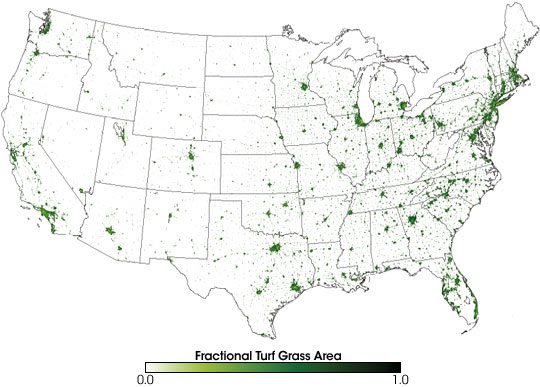
Map courtesy Cristina Milesi, NASA Ames Research Center

As people convert natural landscapes to human-tailored ones, we change the cycling of water and carbon dramatically. Across the United States, water supplies are under increasing pressure as populations grow. Forests and soils that were once a sink for atmospheric carbon can become sources as the natural landscapes are disturbed.

Among the human-tailored landscapes that influence carbon and water cycles in America are lawns. This color-coded map shows satellite-derived estimates of the fractional turf grass (lawn) area across the United States in shades of green. Areas where a large fraction of the land surface is lawn-covered are deepest green, while locations where the lawns cover a very small (or no) fraction of the land surface are lightest green or white.

The map shows how common lawns are across the country, despite a wide variability of climate and soils. Indeed, the scientists who produced the map estimate that more surface area is devoted to lawns than to any other single irrigated crop in the country. For example, lawns appear to cover more than three times the number of acres that irrigated corn covers.

To read more about how NASA-funded scientists developed this map and used it to estimate the impact of lawns on America’s water and carbon cycles, please read Looking for Lawns in the Earth Observatory:

http://earthobservatory.nasa.gov/Study/Lawn/

Saturday, April 22, 2006

Chicken Little May Have a Point


The ongoing purpose of Earth Day is to get people involved in saving the flora & fauna from ultimate extinction due to pollution and global warming. Meanwhile, evidence of global warming increases each year while more species are added to the endangered list. This Mass Extinction site may seem alarmist, but its approx. 200 links give documentation for each scary headline.

Friday, April 21, 2006

An Earth Day With Rain Delays


It may not be a total washout weekend since less rain is forcast for Sunday than Saturday. Of course you should double check the contact info to make sure the events haven't been cancelled:

Saturday, April 22, 2006 (Rain Date: Sunday, April 23)
TITLE OF EVENT: NJDEP Division of Parks and Forestry "EARTH DAY" CHALLENGE
COUNTY: Various
TIME(S): Various
LOCATION: 17 different sites!!! (See website link for complete details)
COST: Free
AUDIENCE: General Public
CONTACT: Various
DESCRIPTION: Whether you help clear a trail, plant a tree, or clean up the beaches – your efforts make a difference in helping to improve the environment. Spend the day in your favorite park and join your friends and neighbors in keeping New Jersey’s state parks beautiful.
This is also a perfect opportunity for service hours for organizations and scouting groups.
Participants should:
Pre-register with the area office.
Wear clothing appropriate for working outdoors.
Bring bottled water and a lunch.
PHONE#: Various
E-MAIL ADDRESS: Michele.Stelle@dep.state.nj.us
WEBSITE: www.nj.gov/dep/parksandforests/parks/earth_day.html

DATE: April, 22 2006
TITLE OF EVENT: Earth Day Celebration
COUNTY: Morris
TIME(S): 11 a.m. - 4 p.m.
LOCATION: Pyramid Mountain Natural Historic Area, Montville, NJ
COST: FREE
AUDIENCE: All ages
CONTACT: Jenny Gaus, Great Swamp Outdoor Education Center
DESCRIPTION: Celebrate Earth Day at one of the Park CommissionÆs premiere natural areas! The day will include hikes, games, live animal demonstrations, and more!
PHONE#: 973-334-3130 or 973-635-6629
WEBSITE: www.morrisparks.net

DATE: April 22nd
TITLE OF EVENT: Earth Day Celebration
COUNTY: Bergen
TIME(S): 10am- 2pm
LOCATION: Wild Birds Unlimited 189 Route 17 South Paramus Nj 07074
COST: None
AUDIENCE: Everyone
CONTACT: Don Torino
DESCRIPTION: Sales on Recycled feeders, presentations by Bergen Audubon, Master Gardeners of bergen county , Native plants
PHONE#: 201-896-0331
E-MAIL ADDRESS: wbupar@aol.com
WEBSITE: www.wbu.com/paramus

Thursday, April 20, 2006

Council Meetings Online? Why Not?


Here's a novel idea. Why can't Town Council and Board of Ed meetings be available online for downloading? Does any township in NJ do it? We found this California town in the news yesterday with a population about the same size as Bloomfield and an income similar to Montclair. Their council chambers appear much like Montclair's except you can hear every word. Another online plus is that you can click to the section of the agenda that interests you the most.

Check out the speaker in the public comments section. You may recognize him.

Tuesday, April 18, 2006

Cool Home Tour


Our President won't take the lead on fighting global warming, but you can! There are very simple things you can do to make your home and lifestyle more energy efficient; in fact, it can be as easy as changing a light bulb.

Walk through a real house on our Cool Home Tour with Sierra magazine's answer man, Mr. Green, and you'll learn how to have a "cool" house, save money, and help chip away at a problem facing us all. Download Mr. Green's Cool Home Checklist and tour your own abode to see what you're doing right and where you have room to improve. It's a great way to celebrate Earth Day.

Monday, April 17, 2006

Zillow 1.1


Zillow.com has just turned on another feature that will probably draw more people to the real estate price-appraisal site. Type in an address for New York City, San Francisco, Boston, Las Vegas, Los Angeles or Seattle and you’ll get an aerial shot of the property, but at a 45-degree angle so you can see the building.
“The images are different from any other sites. You are not getting a rooftop view,” said Spencer Rascoff, chief financial officer and vice president of marketing. “You can see the architectural style, the paint color, how close the house sits to the street,”

The pictures come from a Microsoft partner, Pictometry, one of the world’s largest digital, oblique aerial photography companies. The company said the bird’s eye images will be shown alongside satellite and street maps.

Meanwhile, the company said it now displays information on 65.2 million homes and has price estimates for 47 million of them.

How many of those are vaguely accurate? That’s been the big complaint about the site, even as it has become an online voyeuristic pleasure palace. Mr. Rascoff said the company has improved the algorithm for the My Zestimate, in which a person can correct the data to account for improvements. The original Zestimate algorithm is still a work in progress. He said the problems they have are mostly due to inaccurate data and they are gradually improving that with more data sources.

Zillow is also planning to let homeowners correct the data later this year once they figure out a surefire way to verify that the corrections are reliable. — D.Darlin
NY Times

Sunday, April 16, 2006

Gray is Back and Bloomfield’s Got Him!


Montclair’s Environmental Coordinator, Gray Russell, has just returned from his 3 month fellowship in the UK to study alternative energy programs. This Tuesday at 7:00--like Moses returning from the mountains--Gray will lead off a panel on Renewable Energy at Bloomfield’s Civic Center, 84 Broad St. Also on the panel are Michelle Cuillierer from The NJ Sierra Club, and Susanne Leta from NJPIRG. From the Essex Greens' Press release: ...wind, solar power and ethanol are catching on more and more. As gas prices rise, wind and solar are economically competitive, a way to save money while saving our environment. For more info call 973-338-5398.
Mr. Russell was guest speaker at a Bloomfield Neighborhood Association meeting in 2005

Saturday, April 15, 2006

Property Taxes: How does your town compare?

When it comes to property taxes, making comparisons across towns in New Jersey is no simple matter. To help shed light on the subject, The Star-Ledger is producing a series of articles and interactive features on various aspects of the property tax system.

http://www.nj.com/news/propertytaxes/

This page is home to the statistical tools created for this project. Here you will be able to examine the relationship between taxing and spending in your town and how your town compares to others. You will also find interactive tools dealing with special subjects -- such as the impact of property tax revaluations on local tax levies.

Friday, April 14, 2006

Rates go Higher--Along with Incomes


Mortgage Rates
as of April 14:

30 Year Fixed: 6.49%

15 Year Fixed: 6.14%

1 Year Adj: 5.61%


According to the National Association of Realtors (NAR), home sales should level out and remain at historically high levels in 2006. Existing-home sales will drop 6 percent to 6.65 million from a record 7.08 million in 2005. New-home sales will fall 10.9 percent to 1.14 million from the record 1.28 million last year. Both sectors would see the third-best year following 2005 and 2004. For more information on NAR economic forecast data, go to
http://www.realtor.org/PublicAffairsWeb.nsf/Pages/ HousingForecastApril06.

Wednesday, April 12, 2006

River to River


Third River from Woodland St, Bloomfield. Photo by Geoff Gove from "Bloomfield's Last Wilderness"

We try not to run our river stories back to back but todays NJ Supreme court ruling could have a dramatic effect in curtailing new development projects throughout much of the state. From the Star Ledger:

Court Upholds Water Rules that Limit Growth


A state appeals court today upheld tough water protection regulations against a challenge by the New Jersey Builders Association, which claimed they illegally hamper development.

The builders argued lawmakers never empowered the state Department of Environmental Protection to establish 300-foot “no-build zones” around the state’s most pristine waterways, effectively putting an estimated 300,000 acres off limits to construction.

The three-judge appeals court disagreed, ruling the DEP has that authority under a number of laws, beginning with one passed in 1981 empowering it to “regulate storm water management.”

“The Legislature, in a variety of measures, has given the DEP a wide array of power to address water quality and pollution concerns beyond traditional floodwater control, and to promulgate rules to protect the waters of this state,” the appeals court wrote.

The ruling was a victory for environmentalists and former Gov. James E. McGreevey, who announced the tough rules during a January 2004 news conference. While he said the goal was to “protect the quality of our water supply,” he candidly admitted the regulations were also intended to combat sprawl.

“Part of it is, I don’t want a million new homes in New Jersey,” McGreevey said. He was referring to an oft-repeated estimate that a million residents will move into the Garden State over the next 20 years.

Appellate Division Judge Anthony J. Parrillo wrote the ruling and was joined by Judges Jack Lintner and John S. Holston Jr.

Monday, April 10, 2006

Gone Fishin


GUARDIAN ANGLERS
Excerpted from The Herald News, Apr. 9, 2006
By Gregory J. Rummo

If you drove by any of New Jersey's streams yesterday you may have
noticed gaggles of anglers congregating along the riverbanks. Trout
season opened on Saturday and, as always here in our state where the
fishing is mostly "put-and-take," everyone and his grandmother was
decked out in neoprene, standing elbow-to-elbow in the water, trying
to catch a trout by any of several methods including salmon eggs,
worms, spinners, baitfish and artificial flies.

In most years, Opening Day is more of a ritual than an opportunity to
actually enjoy fishing. It's usually still pretty chilly, fallingshortly after spring's arrival. But nonetheless, it offers anopportunity to get out of the house, where we've been held captive by the elements for the last four months and subjected to shorter hours of daylight.

By May, the crush has subsided. The weather has also warmed and the
trees are starting to leaf out and are filled with warblers, Baltimore
Orioles and other songbirds. It is during this period that the purists
emerge: Those anglers, who believe the best and the only method of
catching the trout is with the artificial fly.

Prior to the Civil War, the Catskills were covered with old-growth forests consisting predominately of hemlocks. These evergreens kept the mountains cool during the summer and their roots held the soil in place.

Vast stands of these majestic trees were clear cut and stripped of their bark. With the shade gone and nothing to
hold back the soil, the rivers of the Catskills warmed and became silted. The native brook trout, a species sensitive to changes in the environment, was driven to extinction in all but the tiniest brooks and creeks at the highest elevations. Populations have never fullyrecovered to this day.

Throughout the 20th century, fly fishing techniques were further
refined, giving rise to a new breed of angler-environmentalists. A
full creel of dead trout no longer was the measure of a successful day
spent on the stream. The focus shifted to learning about the trout's
habitat, the aquatic insects upon which they fed and developing an
acute sensitivity to any environmental threat that could affect
adversely the water quality of the rivers and streams in which the
trout lived. "Catch and release" was practiced on many streams,
ensuring that there would be enough trout for others to enjoy.

I'd like to believe that such a holistic approach to angling would be sufficient to kindle an environmental awareness of the importance of our water resources. We have had more than 100 years to learn from our mistakes when the hallowed streams fished by Gordon were almost destroyed by men bent on plundering the earth's natural resources.

The Pequannock River is a lovely trout stream flowing along the border
of Passaic and Morris Counties. In addition to receiving regular
stockings of rainbow and brook trout, the river nurtures a population
of wild brown trout. The lower portion is a miracle of sorts, tumbling
over algae-slicked rocks as it flows past dumpsters and strip malls
through the suburban hamlets of Bloomingdale, Butler and Riverdale.

But the bigger problem for the Pequannock and its population of wild brown trout is not cosmetic. There's a battle raging over the quality of the water itself.

Ross Kushner is the executive director of the Pequannock River coalition. During the past 10 years, his organization has become concerned about elevated water temperatures in the river which caused a substantial fish kill in 1994 and a less-severe kill in 2002. The organization initiated a temperature monitoring program in 1994 to determine the sources and extent of these problems. Based on the data, several portions of the Pequannock River and several Pequannock River
tributaries were listed as "impaired" for temperature in 2002 and 2004 by the New Jersey Department of Environmental Protection. Additional study by the NJDEP confirmed that lack of sufficient river flow resulting from insufficient water releases from Newark-owned reservoirs is the cause of almost 80 percent of the river's temperature problems.

In August 2004, the NJDEP issued new permit requirements for Newark in its diversion permit for the Pequannock River, including requirements for minimum river flows, both between the city's reservoirs and below their reservoir system that feeds the lower river.

During the summer of 2005, the Pequannock River virtually disappeared
in some places due to a complete lack of water releases from Newark-
owned reservoirs. "Zero flow rate[s] w[ere] seen on the lower
Pequannock without a declared drought," Kushner said. "Also,
temperatures recorded in the lower Pequannock last summer were higher
than any we have measured in the past, topping out at nearly 80
degrees."

The native brook trout of the Catskills were almost driven to extinction during the 1800s by the tannin lords. Will the wild brown trout of the Pequannock suffer a similar fate at the hands of the water lords in Newark?

It's spring now. The weather is cool and there's plenty of water. But summer is coming. Kushner sounds a defiant note: "We insist that the time for action has come. I'm certain we will win in the end. The question is, will the DEP come through on their own, or do we need to haul them into court for failing to meet their obligations?"

Gregory J. Rummo is a businessman, author and syndicated columnist.
Copyright 2006 North Jersey Media Group Inc.


Friday, April 07, 2006

Montclair Gets Another Dis' -- in Belleville


Montclair just can't get any respect these days.
NJ Monthly recently dumped it well down into it's second hundred desirible NJ towns(191 to Maplewood's 38)mainly because of it's skyrocketing home prices. Now we have a major townhome development going up at Belleville & Franklin Aves. What's in a name? Called Essex Park by Centex Homes, "a collection of 262 stacked townhomes." There's no mention that it faces Branchbrook Park. Too Newark? A major selling point is it's proximity to"The Glen Ridge Train Station, Glen Ridge, is approx. 2 miles from Essex Park."Don't look at the two stations in Bloomfield you pass on the way. The home styles are rated by price,from 352k to 464k, Montclair is 3rd rate behind Davenport & Granville.

www.centexhomes.com

Thursday, April 06, 2006

The Micro-MacMansion Movement


Gregory Johnson's "mobile hermitage" in Iowa City, Iowa. (Courtesy of Gregory Johnson)

From The Columbia News Service:
When Gregory Johnson says he lives in a tiny house, he’s not kidding. His entire house--an attractive chalet with a bed, bathroom, dining room table and kitchen--is just 7 feet wide and 10 feet long.

“On vacation most people would love to go and live in some little cottage somewhere, a one-room sparsely furnished facility,” said Johnson, who lives in Iowa City. “Nobody ever thinks to live like that on a day-to-day basis. But what I do is, I try to live every day as though it’s a vacation.”

As the American landscape is increasingly peppered with overgrown palaces that many call “McMansions,” homeowners like Johnson have opted for the opposite extreme. These houses aren’t just small, they’re tiny. And unlike the denizens of cramped apartments in cities, the inhabitants of tiny houses choose to live in them not despite, but because of their miniature size.

Homeowners like Johnson share that frustration and prefer to live in houses without an inch of unused space. Bigger than a child’s playhouse but much smaller than a typical Manhattan studio apartment, the house the 41-year-old built and has lived in since 2003 features metal roofing, exposed stud interior walls and red oak flooring.

The house, which is on wheels and is parked in the backyard of his parents’ house, has been dubbed the “mobile hermitage.” It has electricity and running water, but he chooses not to use them. Instead, he showers at his job each morning and lights the place at night with the LED light from the front of his bicycle. The house has high ceilings and a sleeping loft, which make it feel more spacious, he says.

Johnson, a technology consultant, is the founder of the Small House Society, which has a small but growing mailing list of more than 200, including architecture firms and urban planners. The group’s monthly e-mail newsletter offers tips on everything from housing code battles to homeowners insurance, two common stumbling blocks for enthusiasts.

Many owners of tiny houses are driven by a commitment to preserve the environment. Fewer building materials, they point out, mean reduced building waste. And because the houses are easier (and cheaper) to heat than typical homes, reduced energy usage means decreased greenhouse gas emissions.

“I get claustrophobic in big houses if they’re poorly designed or too crowded,” said Jay Shafer, who started the Tumbleweed Tiny House Co. and helped Johnson build his little house after building his own 70-square-foot home in 1997. “But I don’t get claustrophobic in a small house as long as it’s well made, unless there are too many people inside.”

Tiny houses actually predate McMansions. Henry David Thoreau lived in a house near Walden Pond in Massachusetts that was just 150 square feet.

For others, the draw of tiny houses is far more practical. They can provide a housing alternative when there are no other options.Because they’re built to last and can be set on property later as a guest cottage, the houses, which start at $37,000, will appreciate in value, unlike a trailer.

It’s the anti-FEMA trailer.

Monday, April 03, 2006

Condomania


The condo goldrush is reaching epic proportions in Bloomfield with at least 10 major condo/townhouse/Apt. complexes at various stages of planning -- or recently approved -- by the Planning and/or Zoning Board, most have had major issues raised in opposition by community groups and residents. You may note from our exclusive Bloomfield map above that most are adjacent to The Second & Third Rivers or its tributaties.
Two of the more controversial plans, Church St. and Brookdale School, are scheduled to come before the Zoning Board this Thursday starting at 7:30. A large turnout is expected.

Sunday, April 02, 2006

Build Them and They Will Come

The media is feeding the condo frenzy in this area with stories such as "A Suburban Switch: the Condo's the Thing" in a special supplement to this Sunday's Times.

Here's an excerpt:

For decades, ornate homes with lush yards and multicar garages have been staples of suburban life and the objects of desire of countless families yearning for better schools, safer streets and greener environs far from the city. But as the scarcity of vacant land drove prices to stratospheric highs and many outlying communities began to impose restrictions to curb sprawl, builders trained their eyes on urban neighborhoods.

There they can still buy old or abandoned property at market value, tear it down and replace it with condos, which can be as fancy as a McMansion and as spacious as a single-family home. Though the properties at the high end are not cheap, they typically cost less than a house of comparable luxury and are easier to maintain.

"People that used to be able to afford a 1,200- or 1,500-square-foot home in the suburbs are still moving to the suburbs, but buying a 1,200- or 1,500-square-foot condo instead," said Tim Cashel, a division manager at Baker Residential, a developer in Pleasantville, N.Y., that is building two condominium communities in Bayonne, N.J., a long-neglected city on the Hudson River waterfront.

"Condos have become the new starter home for a lot of these folks," Mr. Cashel said. "But because some of these condos are so posh and so close to the city, they have also become a retirement home for many other people who were already living in the suburbs, but were looking to trade their mansions for a smaller place."

Developers, spotting an opportunity, have been investing in condo construction at a feverish pace. According to the Crittenden Builders Report, a trade publication, the number of new multifamily condo and town house projects increased by about 50 percent nationwide between 2004 and last year.

Much of the new construction has sprouted in urban communities that developers bypassed when they blazed new frontiers deep in the suburbs. Local officials enticed them with tactics like tax incentives, selling public property for a fraction of the price and easing the approval of construction permits. In return, the developers promised to fatten municipal coffers with property tax revenues.

Saturday, April 01, 2006

No Foolin

It isn't pollution that's harming the environment. It's the impurities in our air and water that are doing it. Dan Quayle

Friday, March 31, 2006

EcoVillage a "Living Lab"


(Photo Courtesy EVI EcoVillage)
On April 6, Liz Walker, co-founder and director of
EcoVillage at Ithaca (EVI), will be in Princeton
talking about her experiences initiating, inspiring,
and living in one of the first and most fully-developed
ecovillage communities in the country.

EcoVillage at Ithaca:
A Case Study in Sustainable Community

Thursday evening, April 6 * 7:00 to 9:00 p.m.
43 Maple Street in Princeton (Donation Requested)

EcoVillage at Ithaca is an award-winning "living laboratory" on 175 acres that integrates:

* A village of two cohousing communities with a vibrant, intergenerational mix of 160 people
* Organic, community-supported agriculture (CSA) farms
* Extensive land preservation
* Green building and site design
* Educational facilities
* Regional sustainability initiatives
* On-site employment opportunities

EVI has received extensive media attention, including
two PBS documentaries, CNN and NPR programs, and
articles in The New York Times, The Wall Street
Journal, Residential Architecture, American
Demographics, Mother Earth News, Green Horizon
Quarterly, and many other publications.

Hors d'oeuvres, dessert items, and refreshments will be served.
* * * * * * * * * * * * * * *
For more information or to RSVP (or to make a
contribution if you can't attend) call Steve
at 609-443-6782 or email: ecovillager@msn.com.
Please RSVP if you do plan to attend.
http://www.ecovillage.ithaca.ny.us/