Monday, February 28, 2011

TownStats: Your Window on Local Government


Bloomfield, NJ: March 1 will see the official unveiling of TownStats is the website of the New Jersey Municipal Budget Website Project and was created by The Independent Center, Inc., a non-partisan public policy group dedicated to increasing citizen participation in government, improving public access to government information, and making elections fairer and more democratic. The site was developed in consultation with high-level state and municipal government officials and academics.

The New Jersey Municipal Budget Project was conceived by Tom Byrne and Chris Daggett, co-chairs of the Property Tax and Cost-Cutting Task Force of the Citizens` Campaign: Jersey Call to Service. They were frustrated by the fact that municipal budgets, employee salary data and other critical municipal government information was not readily available to citizens, public officials, community activists, journalists and academics. With a new spending cap in place and state aid likely to be frozen, municipal officials and citizens looking for places to regionalize, share services or find savings needed to be able to compare their towns to towns of similar size and demographics to be able to assess where their spending is high or low and where they can be more efficient.

We did a trial run by running a comparison with Bloomfield, Nutley and Montclair.(click on table to enlarge). It may be a typo, but we're fairly certain that the average residential property value in Bloomfield is at least twice the 140K figure shown. We hope the other stats turn out to be more accurate.

Friday, February 25, 2011

EPA Proves that Where You Live Matters More then How You Live


Smart Growth advocates have long claimed that where you live matters more for energy consumption than what you live in.

Now the Environmental Protection Agency (EPA) confirms it in a new study published on treehugger.com.

The paper finds that a home's location and access to transit -- in other words, its location efficiency -- are as important to reducing energy use as are energy-efficiency measures in homes and cars.
The study also confirms the importance of housing type- that the single family home is an energy hog compared to row housing or multi-family housing.(click on chart to enlarge)


This study illustrates two key points about the effect of compact, location efficient development on energy consumption:
1. A home's location relative to transportation choices has a large impact on energy consumption. People who live in a more compact, transit-accessible area have more housing and transportation choices compared to those who live in spread-out developments where few or no transportation options exist besides driving. Choosing to live in an area with transportation options not only reduces energy consumption, it also can result in significant savings on home energy and transportation costs.

2. Housing type is also a very significant determinant of energy consumption. Fairly substantial differences are seen in detached versus attached homes, but the most striking difference is the variation in energy use between single-family detached homes and multifamily homes, due to the inherent efficiencies from more compact size and shared walls among units. Moderate energy-efficient building technologies, such as those qualifying for Energy Star performance, also generate household energy savings that are notable but not as significant as the housing location and type.

Thursday, February 24, 2011

If You Bought at the Peak of the Market, A Short Sale May Be the Best Option


South Orange, NJ – Many homeowners bought their home at the peak of the market. In the hardest hit areas, they paid $500,000 for homes that are not selling for $250,000 (or even less.) Their home is costing them $4,000 a month. (That is the total after paying property taxes and insurance.) Renters have moved into the neighborhood and are paying less than $2,000 to rent a comparable home.

It just seems like these homeowners are getting an unfair deal all around. Should homeowners dump their homes in favor of a lower priced home? Some people say No! “That is breaking your word. If everyone did it, just think of what would happen?” they say. There is a little problem with that logic. Many of those homeowners see everyone else taking advantage of the system. It has gotten so bad that in some neighborhoods most of the homes have been abandoned.

Why shouldn’t a homeowner do what is best for themselves? After all, they can save hundreds of thousands of dollars. Let’s say they short sale their home with a $500,000 mortgage, rent for 2-3 years, and then buy later. But, what if home prices appreciate over the next few years?

If they are already upside down by 50%, then it still may make financial sense to short sale now. If the housing market has improved by 5% a year, their $250,000 house will have increased to $289,400 in three years. That is still much less than $500,000. In addition, they will save even more on interest payments. I'm not recommending this. I just want to lay out the benefits and leave the decision up to them. Much more on this subject can be found on my short sale blog.

Thinking about a short sale? Discover how other sellers successfully avoided foreclosure by completing a short sale by clicking here.

Thinking about a loan modification? Our Essex County loan modification kit has the instructions you will need to get a loan modification approved with your bank. Click here to request a copy.

Wednesday, February 23, 2011

That One Upside To A Discouraging Housing Market.


If you are a homeowner, then the housing crisis has decimated the equity in your home. Many families have watched years of hard work spent building their equity go down the drain.

But, there is one group benefitting from the crisis: Home Buyers. They are able to buy a home at a substantially reduced price.

In some areas homes are selling for 30-50% lower than they were at the peak. Buyers are now able to buy a nice home at previously unheard off, affordable prices. Homes that were selling for $400,000 are now selling for $225,000. No longer is homeownership in those areas only reserved for the higher income people. Today the “average Joe” can afford to own a nice home. So at least someone is benefitting from the housing crisis.

Where does that leave homeowners stuck with an upside down home? We will detail their options in our next post.

Saturday, February 19, 2011

New Online System for Tax Appeals


Property taxes are expensive, and with the fall in housing prices across the nation, your taxes are more likely than ever to have been assessed unfairly in relation to other homes in your area. That can add up to hundreds and thousands of dollars in overpayment each year–and the problem is, most people won't see a refund unless they speak up. Filing an appeal with your local tax authority used to be an opaque, expensive and time-consuming process–until now.

THE SOLUTION: VALUEAPPEAL
ValueAppeal saves property owners thousands by evaluating their property taxes and then guiding them through a simple 3-step process to create a custom appeal. Their guarantee states that they will refund their $99.00 fee if you lose your appeal.

Wednesday, February 16, 2011

Where We're Moving


More than 10 million Americans moved from one county to another during 2008. Forbes.com has published a map that helps visualize those moves. Once you open this link, you can click on any county to see comings and goings: black lines indicate net inward movement, red lines net outward movement.
Source: Internal Revenue Service data. The IRS only reports inter-county moves for more than 10 people, so some moves are not shown on this map.

Saturday, February 12, 2011

Mortgage Rates Reach 10-month High

As we predicted lasst November when mortgage interest rates bottomed out, rates have continued a steady upswing with few signs of pulling back.
Rates began to climb last week and continued higher in the current period, according to Peter Thompson, a senior loan officer at Prospect Mortgage in Naperville, Ill.

"Rates were in a flat range, where they were pretty much sideways for over a month, and now it has broken out and is going in a higher direction," he says.

The benchmark 30-year fixed-rate mortgage rose 21 basis points this week, to 5.23 percent, according to the Bankrate.com national survey of large lenders.

Thursday, February 10, 2011

5 Ways to Cut Your Electric Bill


Cutting back on your energy usage is one of the best ways to bring down your electricity bill. Making simple changes to not just your wattage consumption but the way your home retains and expels air can dramatically transform the way you experience your spaces and use electricity? Inhabitat.com invited Sustainable pioneer David Johnston to share his tips on how we can better green our homes. Johnston is a green visionary and who focuses on easy changes you can make with your appliances, air exchange, insulation and even windows that will pave the way to dramatic savings. Undoubtedly an expert on all things energy, David shares his over 30 years of experience and gives us a snapshot of some of the best ways we can reduce our energy consumption by up to 50%!

Wednesday, February 02, 2011

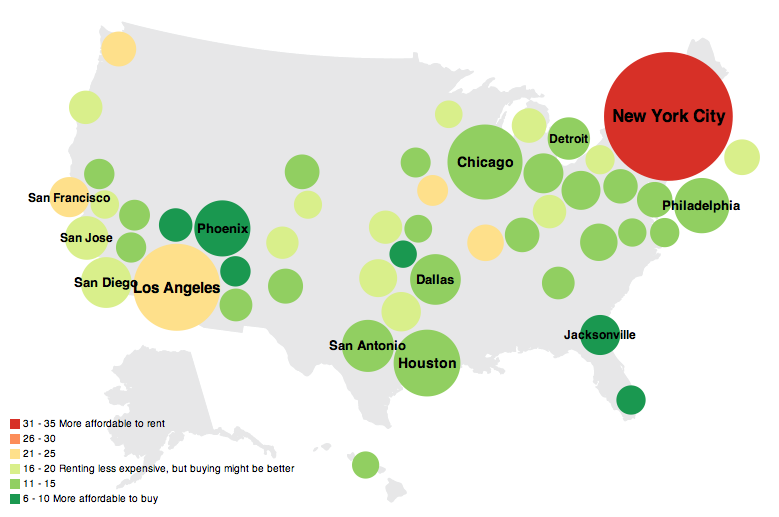
Home Ownership More Affordable in Most of U.S. Yet Most Still Prefer Renting


Trulia.com, a top site for homebuyers, sellers and renters, today released its latest Rent vs. Buy Index which found that it is more affordable to buy than to rent a two-bedroom home[1] in 72 percent of America’s 50 largest cities[2]. Meanwhile, a nation of renters has emerged as more Americans rent by choice or due to unforeseen financial difficulties. In contrast to this nationwide trend, renting is only less expensive than buying in four of the cities included in this study – namely New York, Seattle, Kansas City and San Francisco. The remaining 10 cities are locations where buying may still be a financially sound long-term decision despite the relative affordability of renting.

“Since the start of the ‘Great Recession,’ many former homeowners have flooded the rental market. Following the principles of supply and demand, renting has become relatively more expensive than buying in most markets,” said Pete Flint, CEO and co-founder of Trulia. “Though necessary for achieving true economic recovery, stricter bank lending practices have also further aggravated the struggling housing market in the short term. Even highly-qualified homebuyers face intense scrutiny on their income, savings, existing debt and credit history before they can get a mortgage loan.”

Monday, January 24, 2011

Is This the End of the McMansion Era?


According to Inman news, as well as the National Association of Realtors, the housing slump has led to a reduction in new nome sizing as well as pricing" "The cost of furnishing a bigger house, heating and cooling the structure, and even the commutation between it and the place of employment was always imposing, but now there is no longer the appreciation factor that in the past made the situational sacrifice worth it."

Saturday, January 15, 2011

Why January is the Best Time to Buy


If you are looking to buy a home, then you probably want to get the best deal. January is the best time to be purchasing a home. Let me explain why.

A lot of people put their homes on the market in January. In addition, there are very few people looking to buy a home in January. This is because most of the people transferring for a job have already bought a home. Their companies want them to have purchased by the end of the year so they can write it off on the corporate tax bill.

The remaining buyers are usually waiting until Spring to go house hunting again. This gives you 2-3 months of prime negotiating time.

It is more than likely that you will be the only offers most sellers will see until Spring. But, guess what happens in Spring? All of the other buyers start looking at homes and making offers. Those home sellers now have other options. Your offer isn’t the only one they have on the table. As a result, the seller might pass on an offer that they would have accepted in January. So, if you are looking for a home, get out there and start looking. Don’t let the cold stop you from finding a great deal.

You probably won’t find home prices this low for a while. Everyone is expecting the economy to finally pick up in 2011. This will drive home prices higher..

Wednesday, January 12, 2011

10 Ways to Start Saving Energy at Home


If your New Year’s resolution is to save energy, money, or both: pay attention. You don’t need major investments in solar panels or wind turbines to start cutting energy use and costs. Instead, look for places where you can make small improvements that, collectively, add up to big savings on your monthly bills, while improving your home’s environmental picture. Here are 10 home energy improvements that aren’t out of reach.
1. Beef up insulation: There are quick ways to gauge whether your insulation is up to par, according to the U.S. Department of Energy. For example: if your home was built before the 1980s, if you find yourself shivering/sweating profusely inside your home on a regular basis, or whether your neighbor’s Pomeranian sounds like it’s barking in your living room. Putting the right level of insulation in your walls and ceilings can reduce your heating bills by 20% to 30%
Emagazine wraps up tips 2 through 10 here:

Monday, January 03, 2011

How To Lower Your Mortgage Payment Without A Refi


Yes, You Can Beat The System!

A lot of people in today’s lending market are stuck. They locked in their interest rate when rates were higher. Now, they are barred from refinancing because they are upside down on their house. Whenever they apply for a new loan, the first thing the lender says is, “The current property value is less than what you owe. We can’t lend you enough money to pay off your old lender.” Do they have any options?

Discover how other sellers successfully did a short sale to avoid foreclosure by clicking here. Their best option is probably a loan modification. Their lender is more than likely to work with them since their home dropped in value.

They may have to stop making payments before their lender will approve a loan modification. But, some lenders are even modifying loans that are current.

Some Bloomfield homeowners are stuck with a loan where the payments are going to gradually increase over time. Their current interest rate is 6%. But, it is going to increase by 1% a year until it hits 9.5%.
They can afford the home at the current interest rate. But once it goes higher, they will have to do something. Why not do it now? Take the onetime credit hit and lock in a reasonable interest rate. Some people have been able to get their interest rates on jumbo loans reduced to between 4% and 5%.

Many loan modifications will even reduce your interest rate as low as 2% for 5 years. But, stick to your guns and lock in a reasonable rate for the remainder of the loan. You don’t want to have to apply for another loan mod in 5 years. (Most people don’t see how interest rates could possibly go any lower.)

We offer a loan modification guide to consumers. Here is what we cover in the Stop Foreclosure Institute's Loan Modification Insider Secrets Guide.

* An easy to understand, Step By Step Guidebook.

* How to write a Hardship Letter that gets your loan modification approved.

* Three big loan modification mistakes and how to avoid them.

* Loan Modification from the lenders point of view.

* How the Making Home Affordable Program can help you.

* What not to do so you don't risk being carted off to jail.

* How to calculate your budget properly to increase your chance of success.

To request this kit, please click here to request a copy.

Thinking about a short sale? I can help you short sale your NJ property and never pay the bank another penny. Send me an e-mail at geoffgove@gmail.com. I will contact you for a free consultation.
When we talk, I will explain how the process works in detail and answer any questions you may have. Or, if you prefer, you can call me at (973) 748-1475

Discover how other sellers successfully completed a short sale and request a free consultation by clicking here.
geoffgove@gmail.com.

Wednesday, December 29, 2010

Hemp Houses - the Next Step in Green Building


Dozens of hemp homes have been built in Europe in the past two decades, but they're new to the United States, says David Madera, co-founder of Hemp Technologies, a company that supplied the mixture of ground-up hemp stalks, lime and water.

The industrial hemp is imported because it cannot be grown legally in this country — it comes from the same plant as marijuana. Its new use reflects an increasing effort to make U.S. homes not only energy-efficient but also healthier. Madera and other proponents say hemp-filled walls are non-toxic, mildew-resistant, pest-free and flame-resistant.

Thursday, December 23, 2010

E+Co Named Finalist for the Zayed Future Energy Prize


The Zayed Future Energy Prize announced yesterday that Bloomfield based E+Co has been selected as one of six finalists for this prestigious prize, which honors and rewards individuals, companies, or organizations that are tackling pressing energy issues. The winner, as well as two runners-up, will be announced in Abu Dhabi on January 18th during the World Future Energy Summit.

The Prize recognizes and rewards outstanding work in renewable energy and sustainability. The goal of the annual prize is to educate and inspire future leaders and innovators to combat climate change and global warming, and ensure clean, livable environments for future generations.

Working from a total of 391 submissions from 69 countries, each submission was evaluated based on three key components – long-term vision, innovation and leadership. A shortlist of the top 100 candidates was narrowed to the following finalists, including E+Co. The winner will receive US $1.5 million, with two runners-up receiving up to US $350,000 each.

E+Co is a US based investor in small and growing clean energy enterprises in Africa, Asia and Latin America. With eight regional offices staffed locally, E+Co provides support and capital to enterprises for the purpose of reducing the impact of climate change and energy poverty. Since 1994, E+Co has made 268 investments in 20+ countries totaling US $40 million, bringing clean energy to 6.2 million people and reducing carbon emissions by 4.6 million tons.

For more information please visit www.ZayedFutureEnergyPrize.com.

Thursday, December 16, 2010

Banks Encourage Local Groups to Buy Foreclosures


The National Community Stabilization Trust facilitates the transfer of foreclosed and abandoned properties from financial institutions nationwide to local housing organizations to promote productive property reuse and neighborhood stability. In collaboration with state and local governments, the Stabilization Trust builds local capacity to effectively acquire, manage, rehab and sell foreclosed property to ensure homeownership and rental housing are available to low- and moderate-income families.
The National Community Stabilization Trust has developed the tools necessary to foster neighborhood recovery in the wake of rising foreclosures and property abandonment across America.

Tuesday, December 14, 2010

The Landslide Vote for Conservation


Despite a bad economy, Americans passed 29 of 35 state and local conservation funding measures this election day for a passage rate of 83 percent, making it the most successful year for conservation ballot measures since 1989. The measures passed in these states will result in dedicated funding to protect and restore land and water.

“Americans recognize that even in a tough economy, protecting the waters and lands we need to survive is a top priority,” said Mark Tercek, President and CEO of The Nature Conservancy. “People value clean water and healthy land and are willing to invest to protect them. Congress should follow the voters’ lead and pass conservation legislation before the end of the year.”

Sunday, December 12, 2010

Bank of America Shifts from Origination to Modification


In an effort to deal with the massive influx of loan modification applications and the new, more stringent regulation and supervision of these modifications and approvals, Bank of America is cutting down the size of its loan origination department in favor of altering the state of existing loans instead. Loan originators, who help lenders determine qualifications for mortgages and assist borrowers in obtaining new loans, have had far less to do lately thanks to strict credit requirements and hefty, mandatory down payments. However, since loan modification essentially involves creating new terms for a loan, loan originators are entirely equipped to do this job as well, argues BofA. “The integration of these experienced mortgage professionals will provide Bank of America with a significant surge in servicing capacity,” explained on BofA representative via email.
The lender plans to move around 2,500 employees out of origination and into modification and allow them to remain there for “the majority of 2011.” With the addition of new hires, this will triple BofA’s default service staffing level. BofA also officially assured customers seeking mortgages that their needs will be met quickly and effectively in 2011. Unfortunately, for now, there are just far more modifications needing to be addressed than new loans to be made.
This move reminds us of recent geoplitical events that resulted in our troops being redeployed from Afganistan to Iraq. One can hope the results are more favorable for homeowners.
Posted by Berel News   

Friday, December 03, 2010

You Can Pick Habitat's Most Deserving Community


American Home Shield® has launched the national AHS CHALLENGE FOR CHANGE, an online voting contest that will award $10,000, $15,000 & $25,000 to the three Habitat for Humanity affiliates that receive the most online votes for their neighborhood revitalization initiatives. All participating projects support building and strengthening sustainable communities and will truly change lives. Just by casting your vote, you can help transform a community.
You can vote everyday this month, but today happens to be Double Points Friday. Right now the leaders are in Columbus, O, and Tacoma, Wa., but Morris County,NJ, still has a chance.

Sunday, November 28, 2010

N.J.’s First True ‘passive house’


Teaneck resident Ray Evangelista is building a 4,400-square-foot, two-story colonial that's got everything a homeowner could want except a furnace. The house has been designed so that there will be no need to heat the home in winter or cool it in summer. (Click on diagram to enlarge) from Glen Rock Gazette
An extensive NY Times article goes into detail about what is involved in such projects.

Thursday, November 11, 2010

Rock Bottom?

The advent of QE2 has led many pundits to make hopeful predictions that Mortgage rates would decrease through the winter -- or at least stay at current record lows. In the past few days, we've seen 30 year rates as low as 4.05%.
Now, some are predicting that the Fed's efforts could backfire in it's effect on long term interest rates. They fear that bond holders and buyers might rebel against the lower rates, which could result in rates rising sooner that anticipated. Today's 4.14 Zillow rates (at the right) may just be the beginning. Stay tuned...

Sunday, October 31, 2010

New And Existing Home Sales Rising Faster Than Expected


Some relief may be in store for buyers and sellers spooked by gloomy housing market reports. Sales of new homes climbed 6.6 percent in September. The figures released by the government on Wednesday revealed the second straight month of gains, yet still below the pace when a tax credit existed.

Sales of new single-family homes rose 6.6 percent to a seasonally adjusted annualized rate of 307,000, which is stronger than the 300,000 that economists expected in a MarketWatch-compiled poll.

On Monday, a National Association of Realtors® report showed sales of existing homes also were stronger than expected, rising 10 percent, and the two reports lend support to some economists who believe housing demand hit a bottom in late summer. Existing-home sales rose again in September, affirming that a sales recovery has begun, according to NAR®.

Existing-home sales which are completed transactions that include single-family, townhomes, condominiums and co-ops, jumped 10.0 percent to a seasonally adjusted annual rate of 4.53 million in September from a downwardly revised 4.12 million in August,

Sunday, September 26, 2010

Mega-Mortgage Holders Dropping the Ball With Home Owners


Yesterday, I talked to the owner of a 3 family homer who had fallen behind on his mortgage. He had lost his job and two of his tenants . After getting a lower paying job, he managed to get an agreement for a trial loan modification program through his mortgage holder.He told me that he has made last 5 timely payments on a trial Loan Mod, partly by digging into his savings and was still waiting for closing date. Every time he called for an update, he was referred to an office in a different state. He wound up hiring a lawyer.
Today's NY Times has a story about screw ups by another of the major banks that help explain why the housing market is in such a mess. One of their conclusions is is that if you're facing foreclosure, hang in there! The bank may not even be able to prove they own your mortgage.

Friday, August 27, 2010

Developent Planned Along Third Riverbank's Newest "Pond"


This weeks Bloomfield town council conference meeting saw several developments on a major new development. On the agenda was a discussion of issues related to planned mega conversion of Bloomfield's former National Starch Factory complex at 225 Belleville Ave -- across from Oakside Mansion Recently christened "Oakes Pond," the developer is projecting as many as 390 rental units.to replace a dozen "light manufacturing." facilities. The plan was moved into the Closed Session part of the meeting due to land acquisition and abatement issues that needed to addressed. In the public comment section of the meeting Trish Comstock spoke about traffic problems that already exist in the Belleville Ave. neighborhood. "During rush hours, traffic is frequently backed up (from Broad St.) to Woodland Road."
The current plan by Garden Commercial Properties is to create two buildings along the lower bend of the Third River, four stories each with a parking deck beneath, to serve as luxury one- or two-bedroom apartments. The developer, has said that the properties could begin as rental units and potentially become condominiums. when the real estate market improves.

Commenting on the news of a $100,000 grant received for studying the causes and cures of flooding along Bloomfield's segment of the Third River, Councilman Nick Joanow asserted that "You don't build on a floodplain. There's a cost/benefit analysis that needs to be understood …. Homes along that river have lost 5 to 10 feet of their property due to riverbank erosion. There are homes that are consistently flooding…the water has to go somewhere." He referenced the township's 2002 Master Plan which included the Army Corps of Engineers conclusion that
"The increase in the intensity and number of 100 year and 500 year flood events can be attributed to the way that development has occurred in Bloomfield. Impervious surface coverage along stream corridors in wetlands and floodplain areas leaves stormwater with no place to go. Generally these areas would absorb and filter the waters acting as a natural detention basin for the surrounding community. In Bloomfield, storm water travels through streets, driveways, and sometimes basements, rather than vegetated riparian corridors and wetlands."

Councilman Robert Ruane asserted that arguments on flooding issues caused by development plans along the Third Rive were a diversion for the "fact that the river is full of debris and it has never been cleaned up or dredged." River liaison Bernard Hamilton refuted Ruane by stating that he has personally been involved with several river cleanups. The Mayor concurred with Hamilton.

Tuesday, August 03, 2010

Local Pols Beat Averages for Eco Scorecard


Most legislators posture themselves as being green, but Environment New Jersey, a state-wide citizen-based advocacy group, decided to find out just who was walking the environmental walk -- and who wasn't. In a recently released "scorecard," each member of the state's 213th legislature received a grade from ENJ. "It's important for voters to know where their elected officials stand on the environment. We want to make it easier for them to decide how much the green rhetoric of legislators is matched by their voting record," explained Doug O'Malley, the organization's field director.

The good news from O'Malley is that our local legislators scored pretty well.
While none of them hit the 100% mark (maybe next year?), all but one ranked above average; Senator Kevin O'Toole, (R ), scored a failing 50% in both 2009 an 2010.
Snaps go to our political green champs -- especially the two top scorers -- Ronald Rice and John McKeon. Keep up the good work, fellas.

Ralph Caputo(D), 63%
Joseph Cryan(D) 63%
Sheila Oliver(D) 63%
Dick Codey(D) 63/75%
Ronald Rice(D) 75/75%
John McKeon(D) 88%.

The bad news: The average score for both the State Senate and the State Assembly took a big dip from 70% and 75% respectively to 55%. O'Malley, noted that "this drop reflects an increase in attempts - some successful - to rollback existing environmental protections." He adds that despite this decline in green performance, "there were some stand-outs who were willing to defend the environment time and again, who scored 100% on the scorecard; Asm. Peter Barnes (18), Asw. Linda Greenstein (14), Sen. Bob Smith (17) and Sen. Shirley Turner (15)." Another significant factor in the downward trend are 4 Republican Assembly members -- Asw. Allison Littell McHose (24), Asm. Gary Chiusano (24), Asm. Jay Webber (26) and now retired Asm. Rick Merkt (25), who scored big zeros, bringing the average down considerably.

No scores here for Governor Christie, although he has undertaken several actions that are seen as a step backward by other environmental groups.

Sunday, July 11, 2010

The Bloomfield Real Estate Market c.1900


A century before the Multiple Listing Service and Realtor.com, the best way for a prospective home buyer to find out what was for sale was to walk into a Realtor's shop and see what he had to sell. If he was lucky,he could look at a single black and white print from a 5 x 8 glass plate negative.
Nathan Russell, a turn-of-the-century Realtor, photographed his listings from about 1890 until his death in 1917.  Many were newly constructed when he photographed them. When he died, the pictures remained in his house at 216 Ridgewood Avenue. The day before the demolition began for the new high school, Syd Wilson literally commandeered his good friend Tom Booth to rescue thousands of photos (annotated in Russell's hand) and 5" x 8" glass negatives, each weighing a quarter of a pound, a herculean task.The Russell Collection is now in the Glen Ridge Public Library. 
His listing descriptions contain many selling points that are specific to his day:
"Stable,3 stalls hold 15 tons of hay, 90 bags of oats -- enough to keep 3 horses for one year, Barn on 2nd floor connected by shute to 1st floor...Butler's pantry. In 1904 10 tons of coal used to heat the house & 6 for range... stationary tubs in basement...stable for two horses and two carriages. 'Thatcher' furnace and range...cesspool connection, attic with manhole, chicken coop, trunk room,"

Rich Rockwell, a member of both the Bloomfield Zoning Board and the Historical Society of Bloomfield, has scanned and digitized many of them and put them on the Society's web site.   Many of the photos are indexed by street and house number, but there are nearly 200 that are unidentified. Anyone recognizing any of the photos can comment on them on the web site.  As more are identified, they will be added to the index.

Sunday, June 27, 2010

NJ Still Leads The Toxic Waste Race


As we focus our attention on the overwhelming oil pollution crisis in the gulf states, we shouldn't forget that New Jersey is still the home to the largest number of toxic waste sites in the U.S.

According to The Star Ledger, the state has received over 3 Billion from the national Superfund in the past 30 years including 150 million from the recent stimulus package. Yet only 29 of the designated 142 hazardous waste sites have been completely cleaned up. Authorities are now predicting another 15 to 25 sites could be added to this list over the next 5 years.

The photo above was taken less than 100 yards from my Bloomfield home four years ago. Not sure if it is still considered a Superfund site since extensive funds were laid out by the former owner, Scientific Glass, to clean it to residential standards. They never quite finished the job, though, and the DEP required that tarps cover up what was left as the real estate developer shelved his townhouse plans due to the economy. Meanwhile, the torn tarps and mounds of polluted soil remain.

Sunday, June 13, 2010

Balancing the Scales on Renting Vs Buying


If recent activity is any indication, there are significantly more prospective renters out there than buyers in today's housing market. While there are many reasons folks may have little choice in the matter, there may never be a better time than the present to invest in your own home.
If you crunch the numbers on the mortgage calculator to the right, you will find that you can now get a 3 bedroom entry level home in many Essex Co. suburbs for a monthly payment as low as $1,000 per month. Most 2 BR rentals, on the other hand, start at $1100. Of course property taxes can add $400 to $700/mo to that figure -- you'll get a good chunk back from the IRS from that beloved Homeowner's Deduction.
Combine this with the landlord restrictions on such factors as pets, private driveways, and larger families and renter choices can be very limited. The bottom line is that interest rates have never been lower and have nowhere to go but up.

Tuesday, June 01, 2010

Spring Greening Recycling Design Finalists


After weeks of deliberation on an incredible array of creative reuse projects Inhabitat has just announced the finalists of their 2010 Spring Greening Design Competition.... This year's competition turned up an amazing crop of over 350 entries and after much consideration they've narrowed them down to just 21 finalists who demonstrated an amazing amount of ingenuity, resourcefulness, and creative approach to design reuse. One of my own favorites is above. Can you guess what the source material is before opening this link? Now its up to you to decide who will be the winner of international fame and a $250 gift certificate to the Inhabitat shop -- so cast your vote for your favorite Spring Greening finalist today!

Saturday, May 22, 2010

NJ Leads National Recovery in Home Sales


Along with being number one in blueberry and eggplant production, highway off ramps, and property taxes, New Jersey has now outpaced the rest of the U.S. in sales of homes. According to the National Association of Realtors, New Jersey was one of only three states that showed positive growth in sales volume from the fourth quarter of 2009 to the first quarter of 2010.
New Jersey’s growth in homes sales bucked both the national trend, where sales growth diminished by 14 percent, and the Northeast regional trend, where sales volume dipped by 17.7 percent. The quarterly growth in real estate sales in New Jersey, at 6.8 percent, was the best growth in the nation among high-volume states and was second among all states in the nation, exceeded only by Wyoming.

In a recent Op Ed for The Bergen Record, Jarrod Grasso, CEO of the NJ Association of Realtors cites several reasons for the Garden State's attraction to homebuyers including: the firming up of New Jersey's local markets, and the support for tourism and transportation not to mention proximity to the major markets of New York and Philadelphia.

The nationwide data show that the volume of existing home sales in New Jersey has increased in each of the last four quarters. The Garden State is one of only two states that can boast of this positive trend. Confidence in the market is high, home prices are both reasonable and appropriate, and mortgages are affordable and available.

Tuesday, May 18, 2010

Is it Cheaper to Leave NJ or Stay?


Prevailing wisdom insists that increasing taxes on New Jersey's 16,000 millionaires will cause an irreversible exodus along with the loss thousands of potential jobs in the companies they run. However records appear to indicate otherwise.
Actual tax return data from the New Jersey Department of the Treasury confirm that the number of tax returns with incomes of $500,000 and above has been growing. The current recession may tell a different story in more recent years, but in 2007 (the most recent data available), 48,500 tax returns were filed with incomes of $500,000 or more. This is nearly twice the number (25,500) filed in 2002.
In fact, it seems to be the middle class that is most sensitive to tax pressures, as demonstrated in this video by TheStar Ledger's Brian Donohue. Scroll down for the reader comments that follow,

Tuesday, May 04, 2010

The Take Away About Walking Away


More and more Americans are walking away from their mortgage obligations. A report released by Morgan Stanley indicated that more homeowners are defaulting on their mortgages even though they can afford to pay the loans. According to the New-York based global financial services giant, around 12% of the total number of mortgage defaults in February were “strategic,” up from only 4% in mid-2007.

The report stated that homeowners are more likely to default on their mortgages the higher their credit scores and the larger their loans. It notes that strategic defaults rise based more on how much more borrowers owe in housing debt than the price of their homes.

Industry experts have warned that borrowers who default on their mortgage pose a big risk to the housing market. Morgan Stanley’s report, however, acknowledged the efforts by the Obama administration to address the issue of rising mortgage defaults. The federal government’s policy change “gives us hope that policymakers are serious about curbing future strategic defaults,” the report said, referring to Washington’s plan to amend its anti-foreclosure program to encourage cuts to borrowers’ principal amounts, instead of just the payments they make. As many as 12 million foreclosures will hit the housing market over the next few years if lenders fail to effectively adjust borrowers’ debt.

Sunday, April 18, 2010

How Solar Leasing Can Put Free Solar Panels on Your Roof


In the 4 years since we've started this blog, we've covered several exciting developments in solar technology that have made it more efficient and accessible to homeowners. Yesterday, at Essex County's Earth Day fair we checked out Milburn based Geoscape Solar's intriguing new concept. It's goal is to dramatically expand solar's accessibility and affordability to millions of homeowners. Geoscape Solar’s new leasing program requires no upfront payment - consumers only pay a monthly fee that is lower than the utility cost of the electricity produced by the solar system. The leasing program was created offer homeowners an affordable way to go solar, save money and make a positive impact on the environment. At the Earth Day exhibit, I keyed in my home address and saw my rooftop clearly displayed on Geoscape's computer screen. Calculating the size, pitch and exposure of our roof, our home may be worth considering for a lease arrangement. The catch? Geoscape gets the profits from selling your solar energy back to PSE&G. In return you save 25% off your electricity bills.

Solar energy systems are an investment in one’s home or business – one that provides immediate and ongoing benefits in energy savings and cash income, creating a better environment for families and communities. The company estimates that an average system will save homeowners more than $10,000 over the 15-year lease period. Studies show that the value of your home increases $20 for every $1 per year saved on electricity. Panels will actually extend the life of a roof since they protect it from the elements.

Sunday, April 11, 2010

Spring Cleanup at Clarks Pond Today, 11 -2


Perfect weather to meet your neighbors and help make Bloomfield's Jewel on The Third River sparkle. More info on our Greenway Blog.

Wednesday, April 07, 2010

Keeping Up and Down With FEMA


Living in a Federally declared disaster zone can have benefits that extend beyond those directly affected by the recent flooding. Taxpayers who live or operate businesses in counties designated as federal disaster areas will have certain IRS deadlines postponed until May 11, including the April 15 deadline for filing individual income tax returns, making income tax payments and making 2009 contributions to an individual retirement account. In New Jersey, Atlantic, Bergen, Cape May, Essex, Gloucester, Mercer, Middlesex, Monmouth, Morris, Passaic, Somerset and Union counties were declared federal disaster areas.

On the other hand,home buyers and sellers trying to close a home sale thugs month are facing unexpected hurdles. FEMA has informed mortgage company servicers that "Any appraisal with an inspection date of 3/29 or prior will require re-inspection by the original appraiser and contain the following wording: "...I certify that the inspection revealed no physical damage to the property OR neighborhood…"
If that weren't frustrating enough, all properties under contract in Flood Areas still require flood insurance that can't be bought until Congress extends that provision in yet another bill that was delayed until after their Easter Break.

Thursday, April 01, 2010

In Case You Were Looking for Good News ...


...Standard and Poors Case-Shiller reports that their home price index is improving comparing January 2010 to December 2009. S&P reports that their ten city composite is almost unchanged from where it was 12 months ago (which is a heck of a lot better than a decline). Home prices are trending up in most cities despite a national average 2.5% dip.
On the other hand, it also revealed the sobering fact that 25% of home loan holders are under water. No fooling.

Monday, March 29, 2010

Overdue Bailout for Unemployed Homeowners


The administration unveiled major expansions to its foreclosure prevention plan Friday – expansions designed to help underwater and unemployed homeowners and push it closer to meeting President Obama’s goal of helping 3 to 4 million borrowers save their homes.
Treasury Assistant Secretary Herbert M. Allison pointed out “nature of this housing crisis has changed over the past year,” from a subprime crisis to problems stemming from unemployment and negative equity. Allison says these new program adjustments will give mortgage servicers and originators the flexibility they need to assist “responsible homeowners who have been affected by the economic crisis through no fault of their own.” Faith Schwartz, executive director of the HOPE NOW industry alliance, called the announcement “an important step forward for homeowners, who will now have more options to retain homeownership.” According to ABC News, to qualify for this program, out-of-work homeowners must be eligible for HAMP and be receiving unemployment benefits. The monthly payment would be no more than 30 percent of the homeowner’s unemployment benefits.
To expand the use of principal write-downs as part of the Home Affordable Modification Program (HAMP), participating servicers will be required to consider an “Alternative Modification Waterfall” in their evaluations, which includes writing down some principal for loans that are over 115 percent of the current value of the property (LTV). This alternative modification approach will include incentive payments for each dollar of principal write-down by servicers and investors.

Thursday, March 25, 2010

Bailing Out Main Street. What's Up With B of A?


Bank of America is introducing a program to offer homeowners who owe significantly more than their homes are worth the opportunity to have their loan balances reduced. The program, which starts in May, would potentially help about 45,000 homeowners nationwide. In launching the effort, Bank of America is jumping into the debate about how to address millions of homeowners whose mortgages exceed the value of their homes and who have complicated government efforts to reduce foreclosures. The B of A plan is limited in scope. Borrowers must have missed at least two mortgage payments and be significantly underwater to qualify, owing 20 to 30 percent more than their homes are worth. It is also limited to borrowers with certain types of risky loans, including subprime mortgages or other loans with a two-year adjustable rate.
Bank of America expects to forgive about $3 billion in principal on loans as part of the program. The effort expands a settlement agreement that the bank made in 2008 with several states to modify thousands of mortgages. So what happens now? Homeowners who up till now has managed to make all their payments in time, learn that they don't qualify precisely BECAUSE they made all their payments on time. Wonder how long will that $3B goal will last...

Friday, March 19, 2010

The Big Bailout off Main St.


Our Century 21 Office is just up Main Street from the worst of March Madness in Little Falls. Down Main, at the lowest level in the Signac section, is where hundreds of residents have been forced out for most of the past week. Over the years a tight community has developed among flood prone residents that has resulted in an increasingly active online forum. A couple of posts say a lot about how they are coping:

I am also hoping it misses the 1st floor because that is a whole lot more damage to deal with. I think in 1984 it just missed by a few inches. It also depends where you are on the street, every house is different. Some houses sit in dips along the street. Some of my neighbors only a couple of houses away are a lot higher than me. Unfortunately, it's very hard to say how high it will go in each house. Good Luck!! (Monday 11:49AM)
Three times in 5 years is just ridiculous!!!

Basic clean-up steps involved.... #8 03/15/10 12:41 PM

This is a very basic list and clean-up can be very involved, but just so you have an understanding of what the basics are:
1. When flood levels drop low enough the town will turn on the pumps again. Once the pumps are turned on the water drops rapidly and you can usually go back to the house within hours.
2. Once home, take lots of pictures of the damage. Call your flood insurance right away and notify them that you are going to start removing materials. They should not have any objections and will ask you to take pictures.
3. Next start ripping out 4' high of drywall, insulation and carpeting. The insurance company usually covers materials up to 4' high. If the water level went beyond that speak to your insurance. While you are doing this, ask someone to go out and get plenty of bleach. The Red Cross usually comes around with some, but you are going to use a lot. Also, if you don't have a dehumidifier, go out and get one now.
4. If you have a powerwasher, use it to wash the crawls space, studs, etc. I know it seems crazy to be spraying water when you just got rid of it, but since everything is already soaked you might as well get it cleaned right. The water is sometimes muddy and you don't want that stuff sticking around. This is also a good time to start making calls to your plumber and HVAC to have your furnace fixed or replaced.
5. Mix bleach and water in a big spray can (the big pump kind), ventilate the area really well and spray everything down. I usually do this 3 times over a two day period.
6. Next you want to start drying everything out with dehumidifiers and fans.
7. If the water made it to the air ducts you are also going to want to call someone in to clean them out.
Hope this helps a bit. To answer you question, you usually can move in right after your utilities are back up and running. March is too cold to be living with now heat and hot water.

Sunday, March 14, 2010

House Logic


Houselogic.com is one of the newest of the dozens of homeowner oriented web sites, yet it is one of the few that requires no registration or password to access nearly all of its resources. It also covers perhaps the widest range of subject matter. Whether you are a homeowner or an aspiring homeowner, this site can help resolve any problem that comes to mind -- from financing and taxes to maintenance, repairs, and improvements.
Sponsored by our own National Association of Realtors, it's stated mission is to "help you become the best, most responsible homeowner you aspire to be, we want to provide you with free information and tools you can use to make smart and timely decisions about your home."

Sunday, March 07, 2010

The Ultimate Solution for Housing Market?


Fred Glick is an outspoken realist for the mortgage and real estate world who has appeared on CNBC and NPR's Marketplace. His latest idea could help steady the shaky real estate market AND create thousands of new longer term jobs.
The downward pressure on housing prices is largely due to the rising tide of lower priced foreclosures. The main purchasers of these foreclosures are investors with cash -- not the buyer who needs a home. He is rarely able to get a mortgage for such distressed properties. The buyer usually ends up paying a retail price after the investor flips it.
Why not let the government have these properties fixed up to standards that an owner occupant can finance properly before moving in? This would provide jobs for the construction trades that are hurting and recoup the "bailout", with interest, when the home closes. Fred's bottom line:
 "We gave people jobs, we moved property faster and for more money, we added to the number of mortgages in the system with quality property that made mortgage backed security investors happy and to top it off, we stimulated an economy with the taxpayers making money"

Maybe the Fed Should Listen to Fred.

Wednesday, March 03, 2010

Greener Gadgets for the Home


For four years, the Greener Gadgets Conference has explored sustainable alternatives for the electronics we use in our homes and workplace every day. It has served as a forum for discussing green technology solutions for communication, poverty and education across the globe. Examining eco-friendly products and energy efficient gear, the conference shows off the best ideas from designers worldwide. Each year seems to produce the ultimate in useful innovations. Participants are invited to vote online for their favorites.
The 2010 event, held February 25 in NYC, offered ideas for an entire green lifestyle beginning in the home. The winning design from India(above) was The Go Mechanical Charger)

Friday, February 26, 2010

Digging Out


Our latest Snowmagedden brought back memories of one of the earliest comic books I can remember reading. Little Lulu was a plain Jane ageless pre-teen with a thimble-hat, whose parents were rarely seen or heard, but had countless humorous encounters with her boy friend, Tubby, brother Alvin and her curious puppy.
For this snow-deprived California born lad, her most memorable adventure was digging out of her home alone after a blizzard that left drifts above the roof line. My comic book collection is long gone, but Google brought the circa 1950 story back to life. Loved the fact that she could dig a tunnel for blocks that beelined to the front door of her favorite soda fountain. Holsteins here I come!
(click on images to enlarge)

Sunday, February 21, 2010

Housing Affordability at Near Record Level


(photo of Levittown model home)
The typical American family, who makes the nation’s median income of $64,000 a year, could afford to buy 70.8% of all homes sold in the United States during the last three months of 2009. By comparison, only 55% were affordable in the second quarter of 2008.
The National Association of Home Builders judges a home to be affordable if a family making the median income could devote no more than 28% of their take-home pay toward housing costs.
There was a huge variation in affordability around the nation. All five of the most affordable major housing markets were in the Rust Belt, led by Indianapolis, which has been the nation’s most affordable major metro area for more than four years. More than 95% of all home sold there were classed as within the budget. Detroit was the second most affordable major market with 93.4%. The least affordable city? New York, at 20%.

Monday, February 15, 2010

Homeowners Renting Out Rooms to Avoid Foreclosure


Economic setbacks are forcing increasing numbers of people to reevaluate where and how they live. In addition to former homeowners becoming renters, those who cannot afford their mortgage payments have decided to rent out rooms in their homes to make ends meet. A recent story in The San Jose Mercury News suggests that we are now becoming a nation of “sharers,” as homeowners continue to take in tenants to pay their mortgages. Some may even take in multiple tenants although many towns have restrictions on "Rooming House" zoning. College towns tend to be more tolerant of such setups. My cousin paid off the mortgage on his modest 3BR Palo Alto Ranch home by taking in as many as eight Stanford students at a time for over 30 years.

Wednesday, February 10, 2010

Snowpocolipse in a Warming World


Dr.Jeff Masters puts it in context in his Wunderblog post: It’s not hard at all to get temperatures cold enough for snow in a world experiencing global warming. According to the Intergovernmental Panel on Climate Change. the globe warmed 0.74°C (1.3°F) over the past 100 years. There will still be colder than average winters in a world that is experiencing warming, with plenty of opportunities for snow. The more difficult ingredient for producing a record snowstorm is the requirement of near-record levels of moisture. Global warming theory predicts that global precipitation will increase, and that heavy precipitation events—the ones most likely to cause flash flooding—will also increase. This occurs because as the climate warms, evaporation of moisture from the oceans increases, resulting in more water vapor in the air.

Sunday, February 07, 2010

Open House on Orange St.


Had an interesting encounter with a gent with a different approach to open houses. He's not licensed as a Realtor, but apparently gets paid to snag passers by(like me) who he sees pausing in front of these condo steps -- from the relative warmth of his minivan a couple of houses away. He then shares info about the units and gets a fee from management for showing them. We discussed the sluggish condo market in Bloomfield and he reported that half the 14 units are still unsold after over two years on the market.

Meanwhile, several blocks away on Montgomery Street, sits another just completed block of a dozen townhouses with no sign of life on a Sunday afternoon. They're asking about 100k more. Their 339k unit is the highest priced in Bloomfield. It has been on the market for 443 days. For yet another 100K you can move up to the Brookdale section of Bloomfield where Bloomfield's last woodland forest has been clear cut in half to make way for a much larger development of 42 townhouses.

I've written earlier about my discussion with the aforementioned Liongate developer who seemed unaware of the declining market for condos and townhouses in town. He seems to have had a reality check since the only development to the site in the past year has been a growing pond of stagnant rainwater. Developers continue to be attracted to Bloomfield's proximity to the high end gloss of Montclair and express RR and Bus service to NYC. Commuters are just starting to appreciate the advantages of Bloomfield, but not so much the advantages of condo living.

Tuesday, February 02, 2010

Top 5 Home Improvements Updated


HomeGain.com, one of the first websites to offer Web-based free instant home values, has released the results of its nationwide home improvement and home staging Home Sale Maximizer survey.

HomeGain’s recent survey shows the top do-it-yourself home improvements that Realtors recommend to home sellers. According to their survey, the top five home improvements that Realtors recommend to home sellers based on cost and return on investment (from highest to lowest ROI) are:

1. Cleaning and de-cluttering ($200 cost / $1,700 price increase = 872% ROI)
2. Home staging ($300 cost /$1,780 price increase = 586% ROI)
3. Lightening and brightening ($230 cost / $1,300 price increase = 572% ROI)
4. Landscaping ($320 cost /$1,500 price increase = 473% ROI)
5. Repairing plumbing ($385 cost /$1,250 price increase = 327% ROI)

Cleaning and de-cluttering continues to rank as the top suggested home improvement recommended by 98% of Realtors, costing less than $200 and returning a value of nearly $1,700 to the home’s sale price, or an 872% return on investment.

“Many Realtors agree, especially in a buyer’s market, that sellers who make these recommended home improvements often get their homes sold faster and at higher prices,” stated Louis Cammarosano, General Manager at HomeGain. “We have customized our Home Sale Maximizer online home improvement tool to help identify and prioritize the projects that can increase the salability and selling price of a home.”

Wednesday, January 27, 2010

LEEDing the way in Bloomfield


The Leadership in Energy and Environmental Design (LEED) Green Building Rating System™ encourages and accelerates global adoption of sustainable green building and development practices. LEED is a third-party certification program and the nationally accepted benchmark for the design, construction and operation of high performance green buildings. LEED for Homes is a rating system that promotes the design and construction of high-performance green homes. Green homes use less energy, water and natural resources, create less waste, and are more durable and comfortable for occupants.

One enterprising Bloomfielder we know has spent the last year turning his recently acquired home into the first LEED Platinum home in NJ. We recently photographed the Innards before the drywall was installed. The home includes a geothermal heating and cooling system, energy efficient lighting and plumbing, closed cell foam insulation, zero-VOC paints, sustainable materials, and much more. Tomorrow we tour the nearly completed home. Stay tuned.