Monday, February 28, 2011

TownStats: Your Window on Local Government


Bloomfield, NJ: March 1 will see the official unveiling of TownStats is the website of the New Jersey Municipal Budget Website Project and was created by The Independent Center, Inc., a non-partisan public policy group dedicated to increasing citizen participation in government, improving public access to government information, and making elections fairer and more democratic. The site was developed in consultation with high-level state and municipal government officials and academics.

The New Jersey Municipal Budget Project was conceived by Tom Byrne and Chris Daggett, co-chairs of the Property Tax and Cost-Cutting Task Force of the Citizens` Campaign: Jersey Call to Service. They were frustrated by the fact that municipal budgets, employee salary data and other critical municipal government information was not readily available to citizens, public officials, community activists, journalists and academics. With a new spending cap in place and state aid likely to be frozen, municipal officials and citizens looking for places to regionalize, share services or find savings needed to be able to compare their towns to towns of similar size and demographics to be able to assess where their spending is high or low and where they can be more efficient.

We did a trial run by running a comparison with Bloomfield, Nutley and Montclair.(click on table to enlarge). It may be a typo, but we're fairly certain that the average residential property value in Bloomfield is at least twice the 140K figure shown. We hope the other stats turn out to be more accurate.

Friday, February 25, 2011

EPA Proves that Where You Live Matters More then How You Live


Smart Growth advocates have long claimed that where you live matters more for energy consumption than what you live in.

Now the Environmental Protection Agency (EPA) confirms it in a new study published on treehugger.com.

The paper finds that a home's location and access to transit -- in other words, its location efficiency -- are as important to reducing energy use as are energy-efficiency measures in homes and cars.
The study also confirms the importance of housing type- that the single family home is an energy hog compared to row housing or multi-family housing.(click on chart to enlarge)


This study illustrates two key points about the effect of compact, location efficient development on energy consumption:
1. A home's location relative to transportation choices has a large impact on energy consumption. People who live in a more compact, transit-accessible area have more housing and transportation choices compared to those who live in spread-out developments where few or no transportation options exist besides driving. Choosing to live in an area with transportation options not only reduces energy consumption, it also can result in significant savings on home energy and transportation costs.

2. Housing type is also a very significant determinant of energy consumption. Fairly substantial differences are seen in detached versus attached homes, but the most striking difference is the variation in energy use between single-family detached homes and multifamily homes, due to the inherent efficiencies from more compact size and shared walls among units. Moderate energy-efficient building technologies, such as those qualifying for Energy Star performance, also generate household energy savings that are notable but not as significant as the housing location and type.

Thursday, February 24, 2011

If You Bought at the Peak of the Market, A Short Sale May Be the Best Option


South Orange, NJ – Many homeowners bought their home at the peak of the market. In the hardest hit areas, they paid $500,000 for homes that are not selling for $250,000 (or even less.) Their home is costing them $4,000 a month. (That is the total after paying property taxes and insurance.) Renters have moved into the neighborhood and are paying less than $2,000 to rent a comparable home.

It just seems like these homeowners are getting an unfair deal all around. Should homeowners dump their homes in favor of a lower priced home? Some people say No! “That is breaking your word. If everyone did it, just think of what would happen?” they say. There is a little problem with that logic. Many of those homeowners see everyone else taking advantage of the system. It has gotten so bad that in some neighborhoods most of the homes have been abandoned.

Why shouldn’t a homeowner do what is best for themselves? After all, they can save hundreds of thousands of dollars. Let’s say they short sale their home with a $500,000 mortgage, rent for 2-3 years, and then buy later. But, what if home prices appreciate over the next few years?

If they are already upside down by 50%, then it still may make financial sense to short sale now. If the housing market has improved by 5% a year, their $250,000 house will have increased to $289,400 in three years. That is still much less than $500,000. In addition, they will save even more on interest payments. I'm not recommending this. I just want to lay out the benefits and leave the decision up to them. Much more on this subject can be found on my short sale blog.

Thinking about a short sale? Discover how other sellers successfully avoided foreclosure by completing a short sale by clicking here.

Thinking about a loan modification? Our Essex County loan modification kit has the instructions you will need to get a loan modification approved with your bank. Click here to request a copy.

Wednesday, February 23, 2011

That One Upside To A Discouraging Housing Market.


If you are a homeowner, then the housing crisis has decimated the equity in your home. Many families have watched years of hard work spent building their equity go down the drain.

But, there is one group benefitting from the crisis: Home Buyers. They are able to buy a home at a substantially reduced price.

In some areas homes are selling for 30-50% lower than they were at the peak. Buyers are now able to buy a nice home at previously unheard off, affordable prices. Homes that were selling for $400,000 are now selling for $225,000. No longer is homeownership in those areas only reserved for the higher income people. Today the “average Joe” can afford to own a nice home. So at least someone is benefitting from the housing crisis.

Where does that leave homeowners stuck with an upside down home? We will detail their options in our next post.

Saturday, February 19, 2011

New Online System for Tax Appeals


Property taxes are expensive, and with the fall in housing prices across the nation, your taxes are more likely than ever to have been assessed unfairly in relation to other homes in your area. That can add up to hundreds and thousands of dollars in overpayment each year–and the problem is, most people won't see a refund unless they speak up. Filing an appeal with your local tax authority used to be an opaque, expensive and time-consuming process–until now.

THE SOLUTION: VALUEAPPEAL
ValueAppeal saves property owners thousands by evaluating their property taxes and then guiding them through a simple 3-step process to create a custom appeal. Their guarantee states that they will refund their $99.00 fee if you lose your appeal.

Wednesday, February 16, 2011

Where We're Moving


More than 10 million Americans moved from one county to another during 2008. Forbes.com has published a map that helps visualize those moves. Once you open this link, you can click on any county to see comings and goings: black lines indicate net inward movement, red lines net outward movement.
Source: Internal Revenue Service data. The IRS only reports inter-county moves for more than 10 people, so some moves are not shown on this map.

Saturday, February 12, 2011

Mortgage Rates Reach 10-month High

As we predicted lasst November when mortgage interest rates bottomed out, rates have continued a steady upswing with few signs of pulling back.
Rates began to climb last week and continued higher in the current period, according to Peter Thompson, a senior loan officer at Prospect Mortgage in Naperville, Ill.

"Rates were in a flat range, where they were pretty much sideways for over a month, and now it has broken out and is going in a higher direction," he says.

The benchmark 30-year fixed-rate mortgage rose 21 basis points this week, to 5.23 percent, according to the Bankrate.com national survey of large lenders.

Thursday, February 10, 2011

5 Ways to Cut Your Electric Bill


Cutting back on your energy usage is one of the best ways to bring down your electricity bill. Making simple changes to not just your wattage consumption but the way your home retains and expels air can dramatically transform the way you experience your spaces and use electricity? Inhabitat.com invited Sustainable pioneer David Johnston to share his tips on how we can better green our homes. Johnston is a green visionary and who focuses on easy changes you can make with your appliances, air exchange, insulation and even windows that will pave the way to dramatic savings. Undoubtedly an expert on all things energy, David shares his over 30 years of experience and gives us a snapshot of some of the best ways we can reduce our energy consumption by up to 50%!

Wednesday, February 02, 2011

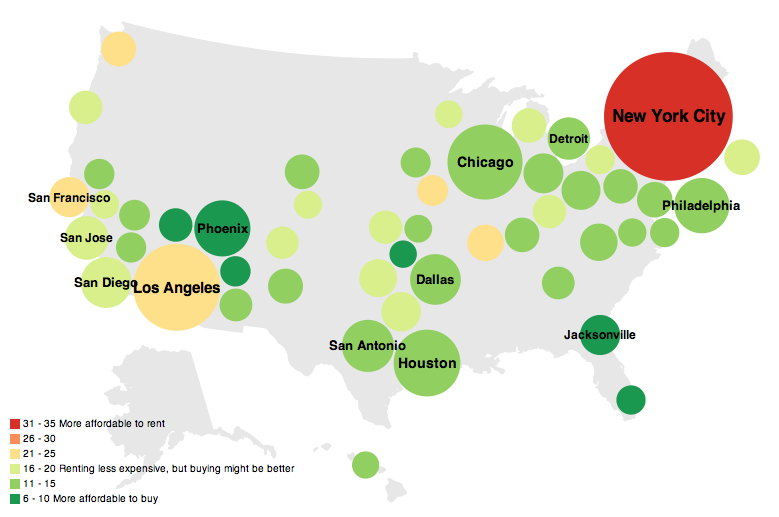
Home Ownership More Affordable in Most of U.S. Yet Most Still Prefer Renting


Trulia.com, a top site for homebuyers, sellers and renters, today released its latest Rent vs. Buy Index which found that it is more affordable to buy than to rent a two-bedroom home[1] in 72 percent of America’s 50 largest cities[2]. Meanwhile, a nation of renters has emerged as more Americans rent by choice or due to unforeseen financial difficulties. In contrast to this nationwide trend, renting is only less expensive than buying in four of the cities included in this study – namely New York, Seattle, Kansas City and San Francisco. The remaining 10 cities are locations where buying may still be a financially sound long-term decision despite the relative affordability of renting.

“Since the start of the ‘Great Recession,’ many former homeowners have flooded the rental market. Following the principles of supply and demand, renting has become relatively more expensive than buying in most markets,” said Pete Flint, CEO and co-founder of Trulia. “Though necessary for achieving true economic recovery, stricter bank lending practices have also further aggravated the struggling housing market in the short term. Even highly-qualified homebuyers face intense scrutiny on their income, savings, existing debt and credit history before they can get a mortgage loan.”

Monday, January 24, 2011

Is This the End of the McMansion Era?


According to Inman news, as well as the National Association of Realtors, the housing slump has led to a reduction in new nome sizing as well as pricing" "The cost of furnishing a bigger house, heating and cooling the structure, and even the commutation between it and the place of employment was always imposing, but now there is no longer the appreciation factor that in the past made the situational sacrifice worth it."

Saturday, January 15, 2011

Why January is the Best Time to Buy


If you are looking to buy a home, then you probably want to get the best deal. January is the best time to be purchasing a home. Let me explain why.

A lot of people put their homes on the market in January. In addition, there are very few people looking to buy a home in January. This is because most of the people transferring for a job have already bought a home. Their companies want them to have purchased by the end of the year so they can write it off on the corporate tax bill.

The remaining buyers are usually waiting until Spring to go house hunting again. This gives you 2-3 months of prime negotiating time.

It is more than likely that you will be the only offers most sellers will see until Spring. But, guess what happens in Spring? All of the other buyers start looking at homes and making offers. Those home sellers now have other options. Your offer isn’t the only one they have on the table. As a result, the seller might pass on an offer that they would have accepted in January. So, if you are looking for a home, get out there and start looking. Don’t let the cold stop you from finding a great deal.

You probably won’t find home prices this low for a while. Everyone is expecting the economy to finally pick up in 2011. This will drive home prices higher..

Wednesday, January 12, 2011

10 Ways to Start Saving Energy at Home


If your New Year’s resolution is to save energy, money, or both: pay attention. You don’t need major investments in solar panels or wind turbines to start cutting energy use and costs. Instead, look for places where you can make small improvements that, collectively, add up to big savings on your monthly bills, while improving your home’s environmental picture. Here are 10 home energy improvements that aren’t out of reach.
1. Beef up insulation: There are quick ways to gauge whether your insulation is up to par, according to the U.S. Department of Energy. For example: if your home was built before the 1980s, if you find yourself shivering/sweating profusely inside your home on a regular basis, or whether your neighbor’s Pomeranian sounds like it’s barking in your living room. Putting the right level of insulation in your walls and ceilings can reduce your heating bills by 20% to 30%
Emagazine wraps up tips 2 through 10 here:

Monday, January 03, 2011

How To Lower Your Mortgage Payment Without A Refi


Yes, You Can Beat The System!

A lot of people in today’s lending market are stuck. They locked in their interest rate when rates were higher. Now, they are barred from refinancing because they are upside down on their house. Whenever they apply for a new loan, the first thing the lender says is, “The current property value is less than what you owe. We can’t lend you enough money to pay off your old lender.” Do they have any options?

Discover how other sellers successfully did a short sale to avoid foreclosure by clicking here. Their best option is probably a loan modification. Their lender is more than likely to work with them since their home dropped in value.

They may have to stop making payments before their lender will approve a loan modification. But, some lenders are even modifying loans that are current.

Some Bloomfield homeowners are stuck with a loan where the payments are going to gradually increase over time. Their current interest rate is 6%. But, it is going to increase by 1% a year until it hits 9.5%.
They can afford the home at the current interest rate. But once it goes higher, they will have to do something. Why not do it now? Take the onetime credit hit and lock in a reasonable interest rate. Some people have been able to get their interest rates on jumbo loans reduced to between 4% and 5%.

Many loan modifications will even reduce your interest rate as low as 2% for 5 years. But, stick to your guns and lock in a reasonable rate for the remainder of the loan. You don’t want to have to apply for another loan mod in 5 years. (Most people don’t see how interest rates could possibly go any lower.)

We offer a loan modification guide to consumers. Here is what we cover in the Stop Foreclosure Institute's Loan Modification Insider Secrets Guide.

* An easy to understand, Step By Step Guidebook.

* How to write a Hardship Letter that gets your loan modification approved.

* Three big loan modification mistakes and how to avoid them.

* Loan Modification from the lenders point of view.

* How the Making Home Affordable Program can help you.

* What not to do so you don't risk being carted off to jail.

* How to calculate your budget properly to increase your chance of success.

To request this kit, please click here to request a copy.

Thinking about a short sale? I can help you short sale your NJ property and never pay the bank another penny. Send me an e-mail at geoffgove@gmail.com. I will contact you for a free consultation.
When we talk, I will explain how the process works in detail and answer any questions you may have. Or, if you prefer, you can call me at (973) 748-1475

Discover how other sellers successfully completed a short sale and request a free consultation by clicking here.
geoffgove@gmail.com.

Wednesday, December 29, 2010

Hemp Houses - the Next Step in Green Building


Dozens of hemp homes have been built in Europe in the past two decades, but they're new to the United States, says David Madera, co-founder of Hemp Technologies, a company that supplied the mixture of ground-up hemp stalks, lime and water.

The industrial hemp is imported because it cannot be grown legally in this country — it comes from the same plant as marijuana. Its new use reflects an increasing effort to make U.S. homes not only energy-efficient but also healthier. Madera and other proponents say hemp-filled walls are non-toxic, mildew-resistant, pest-free and flame-resistant.

Thursday, December 23, 2010

E+Co Named Finalist for the Zayed Future Energy Prize


The Zayed Future Energy Prize announced yesterday that Bloomfield based E+Co has been selected as one of six finalists for this prestigious prize, which honors and rewards individuals, companies, or organizations that are tackling pressing energy issues. The winner, as well as two runners-up, will be announced in Abu Dhabi on January 18th during the World Future Energy Summit.

The Prize recognizes and rewards outstanding work in renewable energy and sustainability. The goal of the annual prize is to educate and inspire future leaders and innovators to combat climate change and global warming, and ensure clean, livable environments for future generations.

Working from a total of 391 submissions from 69 countries, each submission was evaluated based on three key components – long-term vision, innovation and leadership. A shortlist of the top 100 candidates was narrowed to the following finalists, including E+Co. The winner will receive US $1.5 million, with two runners-up receiving up to US $350,000 each.

E+Co is a US based investor in small and growing clean energy enterprises in Africa, Asia and Latin America. With eight regional offices staffed locally, E+Co provides support and capital to enterprises for the purpose of reducing the impact of climate change and energy poverty. Since 1994, E+Co has made 268 investments in 20+ countries totaling US $40 million, bringing clean energy to 6.2 million people and reducing carbon emissions by 4.6 million tons.

For more information please visit www.ZayedFutureEnergyPrize.com.

Thursday, December 16, 2010

Banks Encourage Local Groups to Buy Foreclosures


The National Community Stabilization Trust facilitates the transfer of foreclosed and abandoned properties from financial institutions nationwide to local housing organizations to promote productive property reuse and neighborhood stability. In collaboration with state and local governments, the Stabilization Trust builds local capacity to effectively acquire, manage, rehab and sell foreclosed property to ensure homeownership and rental housing are available to low- and moderate-income families.
The National Community Stabilization Trust has developed the tools necessary to foster neighborhood recovery in the wake of rising foreclosures and property abandonment across America.

Tuesday, December 14, 2010

The Landslide Vote for Conservation


Despite a bad economy, Americans passed 29 of 35 state and local conservation funding measures this election day for a passage rate of 83 percent, making it the most successful year for conservation ballot measures since 1989. The measures passed in these states will result in dedicated funding to protect and restore land and water.

“Americans recognize that even in a tough economy, protecting the waters and lands we need to survive is a top priority,” said Mark Tercek, President and CEO of The Nature Conservancy. “People value clean water and healthy land and are willing to invest to protect them. Congress should follow the voters’ lead and pass conservation legislation before the end of the year.”

Sunday, December 12, 2010

Bank of America Shifts from Origination to Modification


In an effort to deal with the massive influx of loan modification applications and the new, more stringent regulation and supervision of these modifications and approvals, Bank of America is cutting down the size of its loan origination department in favor of altering the state of existing loans instead. Loan originators, who help lenders determine qualifications for mortgages and assist borrowers in obtaining new loans, have had far less to do lately thanks to strict credit requirements and hefty, mandatory down payments. However, since loan modification essentially involves creating new terms for a loan, loan originators are entirely equipped to do this job as well, argues BofA. “The integration of these experienced mortgage professionals will provide Bank of America with a significant surge in servicing capacity,” explained on BofA representative via email.
The lender plans to move around 2,500 employees out of origination and into modification and allow them to remain there for “the majority of 2011.” With the addition of new hires, this will triple BofA’s default service staffing level. BofA also officially assured customers seeking mortgages that their needs will be met quickly and effectively in 2011. Unfortunately, for now, there are just far more modifications needing to be addressed than new loans to be made.
This move reminds us of recent geoplitical events that resulted in our troops being redeployed from Afganistan to Iraq. One can hope the results are more favorable for homeowners.
Posted by Berel News   

Friday, December 03, 2010

You Can Pick Habitat's Most Deserving Community


American Home Shield® has launched the national AHS CHALLENGE FOR CHANGE, an online voting contest that will award $10,000, $15,000 & $25,000 to the three Habitat for Humanity affiliates that receive the most online votes for their neighborhood revitalization initiatives. All participating projects support building and strengthening sustainable communities and will truly change lives. Just by casting your vote, you can help transform a community.
You can vote everyday this month, but today happens to be Double Points Friday. Right now the leaders are in Columbus, O, and Tacoma, Wa., but Morris County,NJ, still has a chance.

Sunday, November 28, 2010

N.J.’s First True ‘passive house’


Teaneck resident Ray Evangelista is building a 4,400-square-foot, two-story colonial that's got everything a homeowner could want except a furnace. The house has been designed so that there will be no need to heat the home in winter or cool it in summer. (Click on diagram to enlarge) from Glen Rock Gazette
An extensive NY Times article goes into detail about what is involved in such projects.