Thursday, April 07, 2011

Realtors® Urge Congress to Approach GSE Reform Slowly


Washington, DC, The National Association of REALTORS® is urging Congress to move cautiously when reforming government-sponsored enterprises Fannie Mae and Freddie Mac.

Reforming America’s housing finance market can only be achieved through a forward-looking, comprehensive approach that supports the housing and economic recoveries, said NAR President Ron Phipps in testimony before the House Subcommittee on Capital Markets today. “As the leading advocate for home ownership, NAR strongly agrees that the existing system failed and that reforms are needed; however, redesigning a viable secondary mortgage model that will protect taxpayer dollars and serve the country’s home owners today, and in the future, can only be achieved through a methodical, measured effort,” said Phipps, broker-president of Phipps Realty in Warwick, R.I.

NAR is concerned that without a comprehensive plan for reforming the secondary mortgage market, proposed legislation to quickly constrain Fannie Mae and Freddie Mac before an adequate replacement secondary mortgage market mechanism is established will further disrupt the still fragile housing market recovery.

“REALTORS® agree that increasing private capital in the mortgage finance market is necessary for a healthy market and for reducing the government’s involvement; however, proposed legislation that relies only on private capital to operate the secondary mortgage market will slow, if not stop, the housing and economic recovery,” he said.

Phipps testified that the pendulum on mortgage credit has already swung too far in the wrong direction and is hurting consumers and the economy. He added that quick decisions aimed at punishing certain market players will only punish the taxpayers by constraining their ability to access affordable mortgage financing, and that making it harder for those who can afford a safe mortgage does not further the goals of the recovery.

“Home ownership is a pillar of our economy. NAR research shows for every two homes sold, a job is created, providing needed revenue to both our state and local economies. This must be considered when debating the future of federal housing policies,” said Phipps.

Tuesday, April 05, 2011

Banks Increasing Incentives to Encourage Short Sales


A year ago, the big news was the government's $8,000 buyer incentive to jump start the housing market. Last summer, Wachovia(now Wells Fargo) began extending cash incentives to homeowners willing to sell their homes as a short sale, rather than going through foreclosure. Borrowers who have found themselves upside down on their Wachovia mortgage could receive 1% of the purchase price (minimum of $2,500) when they sell their home as a short sale. The borrowers get their cash incentive after the successful sale.

More recently, Chase is reported to have raised their ante to as much as $30,000 for higher valued homes. With the Bank's approval borrowers in a short sale sell their property of less than they currently owe in home loans. The lender forgives a portion of the mortgage in order to allow the seller to sell the property.

In the past short sales have been given a bad reputation, often taking longer than a traditional sale, often nine months or longer to obtain the necessary approval of the lender. Many homeowners are intimidated by the whole process and let their home go to foreclosure. They may lose out on a short sale that could in fact be a better choice in the long run.

Banks know that underwater owners are more likely to do a strategic default. Lenders would rather lessen their losses by proactively offering pre-approved short sales to their underwater owners than have the homes go through a foreclosure. Recent studies have proven that the cost of a foreclosure is significantly more than a short sale. Lenders have recently figured out that a short sale ends up saving them money and is in fact quicker than a foreclosure. Wachovia and Chase have set themselves apart from other lenders by turning foreclosures into short sales instead of the other way around. It creates a win-win situation for the homeowner and their Lender.

More info on Short Sales here.

Friday, April 01, 2011

MIT Scientists Create Artificial Solar Leaf That Can Power Homes


An April fools prank? Not likely, since this was published in Inhabitat.com on March 28th. Scientist Dr. David Nocera has perfected a low-cost, artificial leaf-like device, that like a real leaf, mimics the process of photosynthesis. Nocera announced the creation of a miniature solar cell at the National Meeting of the American Chemical Society last week. Nocera hopes to use his “leaf” to help make individual homes capable of becoming their own self-sufficient power stations.

Nocera’s “leaf” is ready for commercial production and distribution. Hopefully one day soon, each home will find it as common as a hot water heater!

Thursday, March 31, 2011

Looking for a Cause -- updated


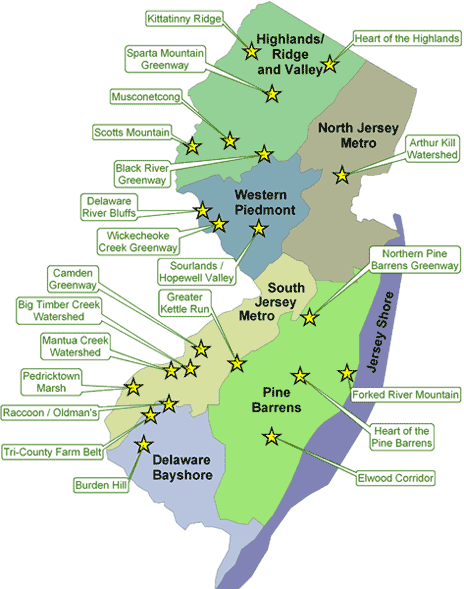
(I ran this piece over 5 years ago. Good to know they're still going strong!)Bloomfield,NJ: The New Jersey Conservation Foundation has preserved over 100,000 acres of land throughout the state to protect our state’s precious natural resources and beautiful natural areas. NJCF’s land protection program focuses on select project areas and greenways that have been identified as critical to our future. From the Highlands to the Pine Barrens to the Delaware Bayshore, NJCF has protected farms, forests, wetlands and urban and suburban parks.
Through acquisition and stewardship, NJCF protects strategic lands; promotes strong land use policies; and forges partnerships to achieve conservation goals. Since 1960, NJCF has protected tens of thousands of acres of open space. For more information, call 1-888-LAND-SAVE, or visit njconservation.org

Monday, March 28, 2011

How a Loan Modification or Short Sale Affects Your credit score?


Bloomfield, NJ – Your credit score will be affected by late mortgage payments and a short sale. However, there are 2 things that are considered horrible on your credit report. Foreclosure and bankruptcy.

Discover how other sellers successfully did a short sale to avoid foreclosure by clicking here.

A foreclosure or bankruptcy will almost immediately lower a credit score by around 100 to 120 points. (The number is not hard and fast – it all depends upon what the score was before the foreclosure, and other factors that the credit bureaus don’t like to share.) The way that they write the algorithm, a foreclosure will keep on pushing your score down for the next 2 years! A foreclosure can also stay on a credit report for 7 years.

Short sales are different from a foreclosure. Short sales and loan modifications by themselves do not hurt a credit score (depending on how they are reported.) It is the missed payments that ding your credit report. How a short sale is coded/reported to the credit reporting bureau does make a difference in the affect it has on your score. It could be reported as a charge-off, a 120 day late payment, or a settled account.

Any of these are dings on the credit report, averaging 100 points. Here is the good news. The way they do the algorithm, it will damage your score for a shorter length of time than the 2 years a foreclosure does.

How a short sale is reported to the credit bureaus is something that can be negotiated as part of the process of the sales negotiations. Good negotiators can have a positive impact here. But, in the end, the credit score should not be the first thing to consider when facing the decision to short sale a home. You need to look at what is best for your family financially. The credit score is secondary to that.

Get advice from a trusted source, and then make an informed decision.

Thursday, March 24, 2011

February Existing Home Sales Decline following Sustained Gains


Washington – Existing-home sales fell in February following three straight monthly increases, according to the National Association of REALTORS®. Existing-home sales, which are completed transactions that include single-family, townhomes, condominiums and co-ops, dropped 9.6 percent to a seasonally adjusted annual rate of 4.88 million in February from an upwardly revised 5.40 million in January, and are 2.8 percent below the 5.02 million pace in February 2010.

Lawrence Yun NAR chief economist, expects an uneven recovery. “Housing affordability conditions have been at record levels and the economy has been improving, but home sales are being constrained by the twin problems of unnecessarily tight credit, and a measurable level of contract cancellations from some appraisals not supporting prices negotiated between buyers and sellers,” he said. “This tug and pull is causing a gradual but uneven recovery. Existing-home sales remain 26.4 percent above the cyclical low last July.”

A parallel NAR practitioner survey2 shows first-time buyers purchased 34 percent of homes in February, up from 29 percent in January; they were 42 percent in February 2010.

All-cash sales were a record 33 percent in February, up from 32 percent in January; they were 27 percent in February 2010. Investors accounted for 19 percent of sales activity in February, down from 23 percent in January; they were 19 percent in February 2010. The balance of sales were to repeat buyers.

The national median existing-home price3 for all housing types was $156,100 in February, which is 5.2 percent below February 2010. Distressed homes – sold at discount – accounted for a 39 percent market share in February, up from 37 percent in January and 35 percent in February 2010. “The decline in price corresponds to the record level of all-cash purchases where buyers – largely investors – are snapping up homes at bargain prices,” Yun explained. “We’d be seeing greater numbers of traditional home buyers if mortgage credit conditions return to normal.”

NAR President Ron Phipps, broker-president of Phipps Realty in Warwick, R.I., said buyers should look into loan availability as soon as they decide they want to buy. “Despite very affordable mortgage interest rates, credit remains a challenge – buyers should check their personal credit, and mortgage availability in their area,” he said.

Tuesday, March 08, 2011

Real Estate Do's and Don'ts


As spring approaches, HGTV's FrontDoor.com is a great resource for anyone wanting to get up to speed in the Real Estate market. They've recently asked some of today's top real estate experts to compile a list of moves to make and mistakes to avoid when buying or selling a home.
Along with their brief but informative video clips, you'll find links dealing with every aspect of home ownership and a search engine for recent MLS listings anywhere in the U.S.

Monday, February 28, 2011

TownStats: Your Window on Local Government


Bloomfield, NJ: March 1 will see the official unveiling of TownStats is the website of the New Jersey Municipal Budget Website Project and was created by The Independent Center, Inc., a non-partisan public policy group dedicated to increasing citizen participation in government, improving public access to government information, and making elections fairer and more democratic. The site was developed in consultation with high-level state and municipal government officials and academics.

The New Jersey Municipal Budget Project was conceived by Tom Byrne and Chris Daggett, co-chairs of the Property Tax and Cost-Cutting Task Force of the Citizens` Campaign: Jersey Call to Service. They were frustrated by the fact that municipal budgets, employee salary data and other critical municipal government information was not readily available to citizens, public officials, community activists, journalists and academics. With a new spending cap in place and state aid likely to be frozen, municipal officials and citizens looking for places to regionalize, share services or find savings needed to be able to compare their towns to towns of similar size and demographics to be able to assess where their spending is high or low and where they can be more efficient.

We did a trial run by running a comparison with Bloomfield, Nutley and Montclair.(click on table to enlarge). It may be a typo, but we're fairly certain that the average residential property value in Bloomfield is at least twice the 140K figure shown. We hope the other stats turn out to be more accurate.

Friday, February 25, 2011

EPA Proves that Where You Live Matters More then How You Live


Smart Growth advocates have long claimed that where you live matters more for energy consumption than what you live in.

Now the Environmental Protection Agency (EPA) confirms it in a new study published on treehugger.com.

The paper finds that a home's location and access to transit -- in other words, its location efficiency -- are as important to reducing energy use as are energy-efficiency measures in homes and cars.
The study also confirms the importance of housing type- that the single family home is an energy hog compared to row housing or multi-family housing.(click on chart to enlarge)


This study illustrates two key points about the effect of compact, location efficient development on energy consumption:
1. A home's location relative to transportation choices has a large impact on energy consumption. People who live in a more compact, transit-accessible area have more housing and transportation choices compared to those who live in spread-out developments where few or no transportation options exist besides driving. Choosing to live in an area with transportation options not only reduces energy consumption, it also can result in significant savings on home energy and transportation costs.

2. Housing type is also a very significant determinant of energy consumption. Fairly substantial differences are seen in detached versus attached homes, but the most striking difference is the variation in energy use between single-family detached homes and multifamily homes, due to the inherent efficiencies from more compact size and shared walls among units. Moderate energy-efficient building technologies, such as those qualifying for Energy Star performance, also generate household energy savings that are notable but not as significant as the housing location and type.

Thursday, February 24, 2011

If You Bought at the Peak of the Market, A Short Sale May Be the Best Option


South Orange, NJ – Many homeowners bought their home at the peak of the market. In the hardest hit areas, they paid $500,000 for homes that are not selling for $250,000 (or even less.) Their home is costing them $4,000 a month. (That is the total after paying property taxes and insurance.) Renters have moved into the neighborhood and are paying less than $2,000 to rent a comparable home.

It just seems like these homeowners are getting an unfair deal all around. Should homeowners dump their homes in favor of a lower priced home? Some people say No! “That is breaking your word. If everyone did it, just think of what would happen?” they say. There is a little problem with that logic. Many of those homeowners see everyone else taking advantage of the system. It has gotten so bad that in some neighborhoods most of the homes have been abandoned.

Why shouldn’t a homeowner do what is best for themselves? After all, they can save hundreds of thousands of dollars. Let’s say they short sale their home with a $500,000 mortgage, rent for 2-3 years, and then buy later. But, what if home prices appreciate over the next few years?

If they are already upside down by 50%, then it still may make financial sense to short sale now. If the housing market has improved by 5% a year, their $250,000 house will have increased to $289,400 in three years. That is still much less than $500,000. In addition, they will save even more on interest payments. I'm not recommending this. I just want to lay out the benefits and leave the decision up to them. Much more on this subject can be found on my short sale blog.

Thinking about a short sale? Discover how other sellers successfully avoided foreclosure by completing a short sale by clicking here.

Thinking about a loan modification? Our Essex County loan modification kit has the instructions you will need to get a loan modification approved with your bank. Click here to request a copy.

Wednesday, February 23, 2011

That One Upside To A Discouraging Housing Market.


If you are a homeowner, then the housing crisis has decimated the equity in your home. Many families have watched years of hard work spent building their equity go down the drain.

But, there is one group benefitting from the crisis: Home Buyers. They are able to buy a home at a substantially reduced price.

In some areas homes are selling for 30-50% lower than they were at the peak. Buyers are now able to buy a nice home at previously unheard off, affordable prices. Homes that were selling for $400,000 are now selling for $225,000. No longer is homeownership in those areas only reserved for the higher income people. Today the “average Joe” can afford to own a nice home. So at least someone is benefitting from the housing crisis.

Where does that leave homeowners stuck with an upside down home? We will detail their options in our next post.

Saturday, February 19, 2011

New Online System for Tax Appeals


Property taxes are expensive, and with the fall in housing prices across the nation, your taxes are more likely than ever to have been assessed unfairly in relation to other homes in your area. That can add up to hundreds and thousands of dollars in overpayment each year–and the problem is, most people won't see a refund unless they speak up. Filing an appeal with your local tax authority used to be an opaque, expensive and time-consuming process–until now.

THE SOLUTION: VALUEAPPEAL
ValueAppeal saves property owners thousands by evaluating their property taxes and then guiding them through a simple 3-step process to create a custom appeal. Their guarantee states that they will refund their $99.00 fee if you lose your appeal.

Wednesday, February 16, 2011

Where We're Moving


More than 10 million Americans moved from one county to another during 2008. Forbes.com has published a map that helps visualize those moves. Once you open this link, you can click on any county to see comings and goings: black lines indicate net inward movement, red lines net outward movement.
Source: Internal Revenue Service data. The IRS only reports inter-county moves for more than 10 people, so some moves are not shown on this map.

Saturday, February 12, 2011

Mortgage Rates Reach 10-month High

As we predicted lasst November when mortgage interest rates bottomed out, rates have continued a steady upswing with few signs of pulling back.
Rates began to climb last week and continued higher in the current period, according to Peter Thompson, a senior loan officer at Prospect Mortgage in Naperville, Ill.

"Rates were in a flat range, where they were pretty much sideways for over a month, and now it has broken out and is going in a higher direction," he says.

The benchmark 30-year fixed-rate mortgage rose 21 basis points this week, to 5.23 percent, according to the Bankrate.com national survey of large lenders.

Thursday, February 10, 2011

5 Ways to Cut Your Electric Bill


Cutting back on your energy usage is one of the best ways to bring down your electricity bill. Making simple changes to not just your wattage consumption but the way your home retains and expels air can dramatically transform the way you experience your spaces and use electricity? Inhabitat.com invited Sustainable pioneer David Johnston to share his tips on how we can better green our homes. Johnston is a green visionary and who focuses on easy changes you can make with your appliances, air exchange, insulation and even windows that will pave the way to dramatic savings. Undoubtedly an expert on all things energy, David shares his over 30 years of experience and gives us a snapshot of some of the best ways we can reduce our energy consumption by up to 50%!

Wednesday, February 02, 2011

Home Ownership More Affordable in Most of U.S. Yet Most Still Prefer Renting


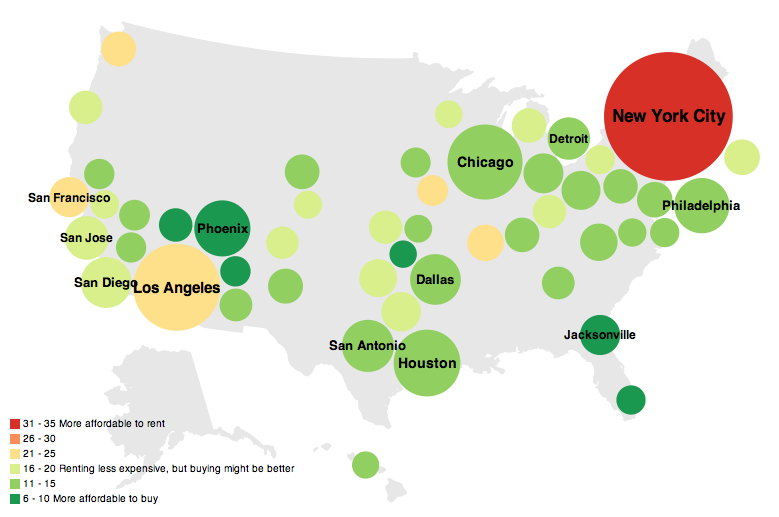
Trulia.com, a top site for homebuyers, sellers and renters, today released its latest Rent vs. Buy Index which found that it is more affordable to buy than to rent a two-bedroom home[1] in 72 percent of America’s 50 largest cities[2]. Meanwhile, a nation of renters has emerged as more Americans rent by choice or due to unforeseen financial difficulties. In contrast to this nationwide trend, renting is only less expensive than buying in four of the cities included in this study – namely New York, Seattle, Kansas City and San Francisco. The remaining 10 cities are locations where buying may still be a financially sound long-term decision despite the relative affordability of renting.

“Since the start of the ‘Great Recession,’ many former homeowners have flooded the rental market. Following the principles of supply and demand, renting has become relatively more expensive than buying in most markets,” said Pete Flint, CEO and co-founder of Trulia. “Though necessary for achieving true economic recovery, stricter bank lending practices have also further aggravated the struggling housing market in the short term. Even highly-qualified homebuyers face intense scrutiny on their income, savings, existing debt and credit history before they can get a mortgage loan.”

Monday, January 24, 2011

Is This the End of the McMansion Era?


According to Inman news, as well as the National Association of Realtors, the housing slump has led to a reduction in new nome sizing as well as pricing" "The cost of furnishing a bigger house, heating and cooling the structure, and even the commutation between it and the place of employment was always imposing, but now there is no longer the appreciation factor that in the past made the situational sacrifice worth it."

Saturday, January 15, 2011

Why January is the Best Time to Buy


If you are looking to buy a home, then you probably want to get the best deal. January is the best time to be purchasing a home. Let me explain why.

A lot of people put their homes on the market in January. In addition, there are very few people looking to buy a home in January. This is because most of the people transferring for a job have already bought a home. Their companies want them to have purchased by the end of the year so they can write it off on the corporate tax bill.

The remaining buyers are usually waiting until Spring to go house hunting again. This gives you 2-3 months of prime negotiating time.

It is more than likely that you will be the only offers most sellers will see until Spring. But, guess what happens in Spring? All of the other buyers start looking at homes and making offers. Those home sellers now have other options. Your offer isn’t the only one they have on the table. As a result, the seller might pass on an offer that they would have accepted in January. So, if you are looking for a home, get out there and start looking. Don’t let the cold stop you from finding a great deal.

You probably won’t find home prices this low for a while. Everyone is expecting the economy to finally pick up in 2011. This will drive home prices higher..

Wednesday, January 12, 2011

10 Ways to Start Saving Energy at Home


If your New Year’s resolution is to save energy, money, or both: pay attention. You don’t need major investments in solar panels or wind turbines to start cutting energy use and costs. Instead, look for places where you can make small improvements that, collectively, add up to big savings on your monthly bills, while improving your home’s environmental picture. Here are 10 home energy improvements that aren’t out of reach.
1. Beef up insulation: There are quick ways to gauge whether your insulation is up to par, according to the U.S. Department of Energy. For example: if your home was built before the 1980s, if you find yourself shivering/sweating profusely inside your home on a regular basis, or whether your neighbor’s Pomeranian sounds like it’s barking in your living room. Putting the right level of insulation in your walls and ceilings can reduce your heating bills by 20% to 30%
Emagazine wraps up tips 2 through 10 here:

Monday, January 03, 2011

How To Lower Your Mortgage Payment Without A Refi


Yes, You Can Beat The System!

A lot of people in today’s lending market are stuck. They locked in their interest rate when rates were higher. Now, they are barred from refinancing because they are upside down on their house. Whenever they apply for a new loan, the first thing the lender says is, “The current property value is less than what you owe. We can’t lend you enough money to pay off your old lender.” Do they have any options?

Discover how other sellers successfully did a short sale to avoid foreclosure by clicking here. Their best option is probably a loan modification. Their lender is more than likely to work with them since their home dropped in value.

They may have to stop making payments before their lender will approve a loan modification. But, some lenders are even modifying loans that are current.

Some Bloomfield homeowners are stuck with a loan where the payments are going to gradually increase over time. Their current interest rate is 6%. But, it is going to increase by 1% a year until it hits 9.5%.
They can afford the home at the current interest rate. But once it goes higher, they will have to do something. Why not do it now? Take the onetime credit hit and lock in a reasonable interest rate. Some people have been able to get their interest rates on jumbo loans reduced to between 4% and 5%.

Many loan modifications will even reduce your interest rate as low as 2% for 5 years. But, stick to your guns and lock in a reasonable rate for the remainder of the loan. You don’t want to have to apply for another loan mod in 5 years. (Most people don’t see how interest rates could possibly go any lower.)

We offer a loan modification guide to consumers. Here is what we cover in the Stop Foreclosure Institute's Loan Modification Insider Secrets Guide.

* An easy to understand, Step By Step Guidebook.

* How to write a Hardship Letter that gets your loan modification approved.

* Three big loan modification mistakes and how to avoid them.

* Loan Modification from the lenders point of view.

* How the Making Home Affordable Program can help you.

* What not to do so you don't risk being carted off to jail.

* How to calculate your budget properly to increase your chance of success.

To request this kit, please click here to request a copy.

Thinking about a short sale? I can help you short sale your NJ property and never pay the bank another penny. Send me an e-mail at geoffgove@gmail.com. I will contact you for a free consultation.
When we talk, I will explain how the process works in detail and answer any questions you may have. Or, if you prefer, you can call me at (973) 748-1475

Discover how other sellers successfully completed a short sale and request a free consultation by clicking here.
geoffgove@gmail.com.